
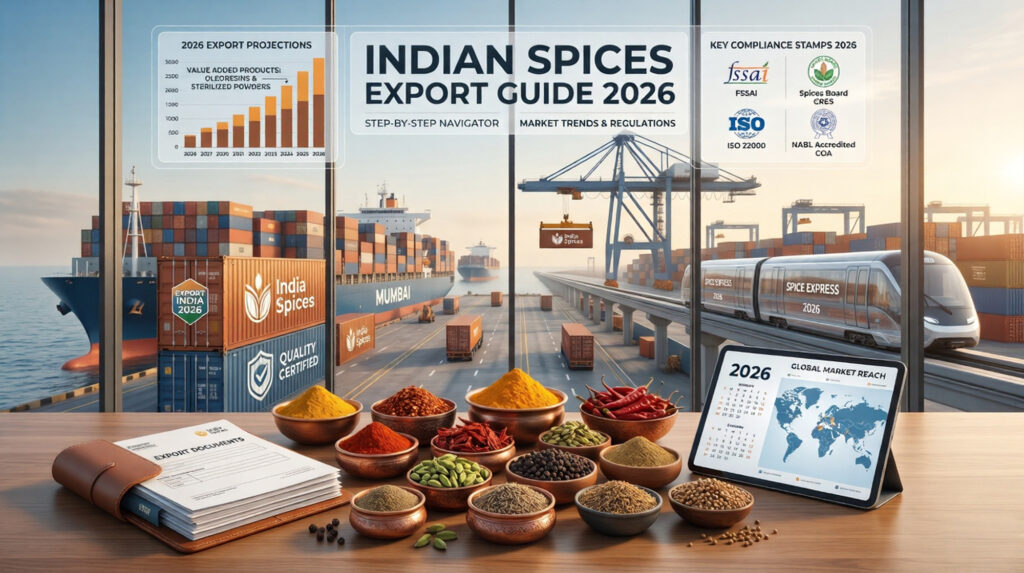
India is not just a spice exporter — it is the world’s spice capital. No country comes close to India’s diversity, volume, and centuries-old expertise in producing, processing, and exporting spices. From the cardamom hills of Kerala to the chilli fields of Andhra Pradesh and the cumin farms of Rajasthan, every state contributes to India’s unmatched spice heritage.
In 2026, Indian spice exports have crossed $4.5 billion annually and continue to grow as global demand for natural flavours, health-focused cooking, and ethnic cuisines rises worldwide. This guide walks you through every step of the spice export process — from understanding what to export to getting paid safely.
What’s in this guide
- India’s spice export landscape 2026
- Top Indian spices for export
- Best export markets for Indian spices
- Who can export spices from India?
- Licences & registrations required
- Quality standards & certifications
- Packaging & labelling requirements
- Step-by-step export process
- Pricing, payment & Incoterms
- FTA & duty advantages
- Common mistakes to avoid
- FAQs
India’s spice export landscape in 2026
India’s dominance in the global spice trade is not recent — it spans thousands of years. What has changed in 2026 is the sophistication of the market: buyers are not just looking for raw dried spices, but for certified organic, single-origin, value-added spice products that tell a story and meet strict food safety standards.
Three key trends are shaping Indian spice exports in 2026:
Organic & natural demand surge
Global demand for organic certified spices is growing 12%+ annually. Buyers in EU, USA, Japan, and Australia pay 40–80% premium for NPOP/USDA organic-certified Indian spices. This is the single biggest value-add opportunity for Indian spice exporters.
Value-added products
Spice oils, oleoresins, extracts, blends, and ready-to-use spice mixes command 3–5x the price of raw dried spices. Indian processors who move up the value chain from commodity to processed products significantly increase their export earnings.
Traceability & food safety
Post-COVID, EU and US importers demand farm-to-shelf traceability, lower pesticide residue limits, and fully documented supply chains. Indian exporters who invest in lab testing, digital traceability systems, and FSSAI compliance are winning market share from those who don’t.
The Spices Board of India — under the Ministry of Commerce — is the nodal agency that regulates, promotes, and develops India’s spice industry. Every Indian spice exporter must register with the Spices Board. It sets quality standards, issues certificates, promotes at international trade fairs, and provides technical support to exporters. Website: indianspices.com
Top Indian spices for export in 2026
India exports 75+ varieties of spices in whole, ground, and processed forms. Here are the most significant categories by volume, value, and export growth:
Other major Indian spice exports include:
Black & white pepper
The “king of spices.” Kerala’s Malabar pepper is globally renowned. India exports ~$180M annually. Key markets: USA, Vietnam, Germany, Netherlands, UK. Malabar Garbled (MG1) is the premium export grade.
Coriander (Dhaniya)
India is the world’s largest coriander producer. Rajasthan and Madhya Pradesh are the main hubs. Exports: ~$150M annually. Used in food processing, essential oil extraction, and pharmaceutical applications. Markets: Malaysia, UAE, USA, Sri Lanka.
Ginger (Adrak)
India is the world’s largest ginger producer. Exported as fresh ginger, dried ginger, ginger powder, ginger oil, and oleoresin. Kerala, Meghalaya, and Himachal Pradesh are key producers. Markets: USA, UAE, Bangladesh, UK, Japan.
Fennel (Saunf)
Gujarat (Saurashtra) and Rajasthan are major fennel producers. Used in food processing, pharmaceutical, and personal care industries globally. India exports ~$80M annually. Good organic premium available.
Fenugreek (Methi)
India produces 85% of the world’s fenugreek. Rajasthan is the primary producer (Sirohi, Nagaur). Fenugreek seeds and leaves are exported widely. Growing demand for nutraceutical applications (testosterone support, glucose management) is pushing premium prices.
Cloves, Nutmeg & Mace
Kerala is India’s primary producer of cloves and nutmeg. While Indonesia dominates global production, Kerala’s high-quality cloves and nutmeg command premium prices in EU and USA markets. Clove oil and nutmeg butter are high-value processed exports.
Best export markets for Indian spices in 2026
India exports spices to 180+ countries. These are the most important markets, why they matter, and what they specifically demand:
| Country | Export value | Most demanded spices | Key requirement |
|---|---|---|---|
| 🇺🇸 USA | ~$750M+ | Chilli, pepper, turmeric, cumin, coriander | FDA registration, pesticide residue limits |
| 🇨🇭 China | ~$400M+ | Chilli, cumin, ginger, turmeric | CIQ clearance, Chinese standards |
| 🇦🇪 UAE | ~$300M+ | Cardamom, chilli, turmeric, cumin, pepper | CEPA 0% duty, ESMA compliance |
| 🇧🇩 Bangladesh | ~$300M+ | Chilli, cumin, coriander, turmeric | SAFTA rates, land border LCS |
| 🇲🇱 Malaysia | ~$200M+ | Pepper, chilli, cumin, coriander, fennel | ASEAN FTA, Halal certification |
| 🇩🇪 Germany/EU | ~$180M+ | Pepper, cumin, coriander, organic spices | EU MRL compliance, organic cert |
| 🇸🇦 Saudi Arabia | ~$150M+ | Cardamom, pepper, cumin, ginger | SASO standards, Halal cert |
| 🇬🇧 UK | ~$120M+ | Chilli, turmeric, cumin, coriander, garam masala | UK MRL limits, FTA 2026 |
UAE + CEPA strategy: The UAE CEPA gives Indian spices 0% duty access, and Dubai is the world’s largest spice re-export hub — Indian spices shipped to Dubai are redistributed to 140+ countries in the Middle East, Africa, and South Asia. A UAE buyer relationship can multiply your market reach significantly.
Who can export spices from India?
Any of the following business entities can export spices from India, provided they have the required registrations:
Spice farmers & FPOs
Farmer Producer Organisations and individual farmers with processing capability can export directly with APEDA and Spices Board registration.
Spice traders & aggregators
Buy from farmers/APMCs, clean/grade/pack, and export. Most common exporter type. Need all standard registrations plus Spices Board certificate.
Spice processors
Produce ground spices, oleoresins, essential oils, and spice blends. Higher margins. Need Food Processing licence, FSSAI, and Spices Board certification.
Spice brands & FMCG
Consumer-packaged spice brands exporting retail-ready products. Need all registrations plus country-specific food labelling compliance and possibly brand trademark registration in target countries.
Licences & registrations required for spice exports
Unlike some other export categories, spice exports have a specific set of mandatory registrations beyond the standard IEC and GSTIN. Get these in place before your first shipment:
Quality standards & testing requirements
Quality is the single most critical factor in maintaining and growing your spice export business. Buyers in the USA, EU, and Japan have strict Maximum Residue Limits (MRL) for pesticides, heavy metals, aflatoxins, and microbial contamination. Failing these tests leads to shipment rejection, reputation damage, and import bans.
📊 Spices Board quality parameters
The Spices Board has set quality standards for each spice covering: moisture content, volatile oil content, ash content, foreign matter, and purity. Exporters must meet Spices Board grading standards before receiving an export certificate.
🌿 MRL (pesticide residue limits)
EU has the world’s strictest MRL limits for spices. USA FDA also tests for pesticide residues. A single consignment above EU MRL triggers RASFF (Rapid Alert System for Food and Feed) notification and can lead to enhanced border inspection — affecting all future shipments from that exporter.
💊 Aflatoxin testing
Aflatoxins (produced by Aspergillus fungi) are a major issue for chillies and paprika. EU limit: 10 ppb (total aflatoxins). USA limit: 20 ppb. Spice batches must be tested at NABL-accredited labs for aflatoxin B1, B2, G1, G2 before export. Proper drying and storage is the primary prevention.
📊 Microbiological testing
Total plate count, Salmonella, E. coli, yeast & mould counts are tested. Steam sterilisation or ETO (ethylene oxide) treatment is used to reduce microbial load — however, ETO treatment is now banned in EU. EU-bound spice exporters must use steam or irradiation instead.
The ETO ban is critical for EU exporters: Ethylene oxide (ETO) treatment has been the standard microbial decontamination method for spices in India. However, the EU has banned ETO residues in food products. Indian spice exporters targeting the EU must switch to steam sterilisation or irradiation and test for ETO residues before every EU-bound shipment. Non-compliance results in RASFF alerts and shipment destruction at EU ports.
Packaging & labelling requirements for spice exports
Packaging is not just aesthetics — it directly impacts quality preservation, customs compliance, buyer acceptance, and retail shelf appeal. Here is what you need to know:
📦 Bulk packaging (B2B)
Most spice exports to food processors and spice traders are in bulk. Standard formats: 25kg/50kg PP woven bags with inner HDPE liner, 25kg fibre drums (for oleoresins/oils), 20kg corrugated cartons with poly liner (for powders).
🧐 Retail packaging (B2C)
Consumer-facing spice exports to ethnic food retailers and supermarkets: stand-up pouches (50g–500g), glass jars, tins, or pillow pouches with zip-lock. Nitrogen flushing or vacuum sealing extends shelf life. Packaging must meet destination country food packaging standards.
🏭 Storage & handling
Spices must be stored in cool (below 25°C), dry (below 65% RH), clean, and pest-free warehouses. FIFO (First In, First Out) inventory management. Separate storage from other strong-odour products. Wooden pallets must be ISPM 15 fumigated.
Mandatory labelling information for exported spice packages
| Label element | India (Spices Board) | EU requirement | USA (FDA) requirement |
|---|---|---|---|
| Product name | ✓ Variety & type | ✓ Botanical name required | ✓ Common name |
| Net weight | ✓ Metric units | ✓ Grams/kg | ✓ Oz & grams |
| Country of origin | ✓ “Product of India” | ✓ Mandatory | ✓ Mandatory |
| Lot / batch number | ✓ For traceability | ✓ Mandatory | ✓ Mandatory |
| Best before date | ✓ Month/Year | ✓ Mandatory | ✓ Expiration date |
| FSSAI licence no. | ✓ Required on label | ✗ Not required | ✗ Not required |
| Allergen declaration | Conditional | ✓ Mandatory (14 allergens) | ✓ Major allergens |
Step-by-step process to export spices from India
Follow these steps in sequence for your first successful spice export shipment:
Business registration & IEC
Register your business (proprietorship/Pvt Ltd/LLP), get PAN, GSTIN, open a current bank account with AD code, and apply for IEC at dgft.gov.in. Timeline: 1–2 weeks.
Spice-specific registrations
Apply simultaneously for: Spices Board registration (indianspices.com), FSSAI Central Licence (fssai.gov.in), and APEDA registration (apeda.gov.in). File GST LUT before April 1. Timeline: 3–6 weeks.
Source, grade & process spices
Source from APMC markets or farmers, clean and grade to Spices Board quality parameters. Dry to required moisture levels. Process (grind/blend/extract) if applicable. Ensure proper storage in clean, pest-free warehouses.
Lab testing
Get the batch tested at a NABL-accredited lab for: pesticide residues (MRL compliance for target country), aflatoxins, microbial count, moisture, volatile oil, and ash. Lab certificate must accompany every shipment.
Find buyers & negotiate
Use Spices Board trade fair participation, IndiaMART, Alibaba, LinkedIn, and APEDA buyer-seller meets. Attend the World Spice Congress. Register on Spices Board’s buyer-seller platform. Send samples with lab reports.
Prepare export documents
Commercial Invoice, Packing List, Shipping Bill (ICEGATE), Phytosanitary Certificate (NPPO), Spices Board Certificate of Origin/Quality Certificate, FSSAI Certificate, Certificate of Origin (APEDA for FTA markets), lab test report.
Customs clearance & shipment
Your CHA (Customs House Agent) files the Shipping Bill on ICEGATE, submits physical inspection if required, obtains Let Export Order (LEO), and coordinates with freight forwarder/shipping line for loading. Book sea freight (most common for spices) or air for high-value small consignments.
Payment realisation & incentives
Receive payment via LC/TT. Ensure e-BRC is generated by your bank. Claim RoDTEP scrips on ICEGATE. File GST refund if applicable. Claim APEDA’s Market Development Assistance (MDA) for trade fair reimbursements.
Pricing, payment terms & Incoterms for spice exports
Correct pricing is what separates profitable spice exporters from those who lose money on every shipment. Here is the framework:
💰 Export price build-up (FOB basis)
📋 Recommended Incoterms for spices
💰 Payment terms
FTA & duty advantages for Indian spice exporters
India’s growing FTA network provides significant tariff advantages for spice exporters in key markets. Here is how to use them:
UAE CEPA — 0% duty
Indian spices enter UAE at 0% customs duty under the CEPA. Previously 5% duty. For a $1M spice shipment, that’s $50,000 saved immediately. Get a CEPA Certificate of Origin from FIEO/APEDA for each shipment.
✓ CEPA CoO requiredAustralia ECTA — reduced duty
Most Indian spices enter Australia at 0% under ECTA (was 5%). Australia is a growing market for Indian spices, herbs, and organic products with a large Indian diaspora driving demand. Obtain AIFTA CoO from FIEO.
✓ AIFTA CoO requiredASEAN FTA — 0–5% duty
India’s ASEAN FTA covers Malaysia, Thailand, Vietnam, Indonesia, Singapore, Philippines, and others. Spice duties range from 0–5% for ASEAN FTA eligible products. Form AI CoO required.
✓ Form AI CoO requiredJapan CEPA — reduced tariffs
Japan CEPA provides preferential tariff access for Indian spices including pepper, ginger, turmeric, and others. Japan values high-quality, traceable spices and pays premium prices. Form ISAI CoO required.
✓ Form ISAI CoO requiredRoDTEP benefit for spice exporters: Under the RoDTEP (Remission of Duties and Taxes on Exported Products) scheme, spice exporters receive credit scrips for embedded taxes. The rate varies by HS code (typically 0.5–2% of FOB value). These scrips are transferable and can be used to pay customs duties or sold — a direct addition to your export margin. File for RoDTEP on ICEGATE after every shipment.
Common mistakes in Indian spice exports to avoid
Skipping pre-shipment lab testing
Testing seems like an unnecessary cost until your first shipment gets rejected at Rotterdam port for MRL violation. A ₹5,000 lab test can save a ₹50-lakh rejection, port detention costs, and permanent damage to your importer relationship.
Using ETO treatment for EU shipments
ETO residues in spices are illegal in the EU. This ban has resulted in hundreds of Indian spice shipments being rejected. If you are exporting to EU, switch to steam sterilisation and always test for ETO residues. This is non-negotiable.
Poor moisture management
Spices with excessive moisture content (above the Spices Board limit) develop mould, lose aroma, and are rejected at destination. Always dry to specified moisture levels and use moisture-proof packaging. Test moisture before packing every batch.
No Phytosanitary Certificate
Most countries require a Phytosanitary Certificate for spice imports. This is issued by India’s NPPO (state agricultural departments). Apply 5–7 days before shipment. Missing or incorrect phytosanitary certificates lead to quarantine holds at destination ports.
Exporting adulterated or mixed varieties
Adulterating spices (mixing cheaper varieties, adding fillers, or mislabelling origin) is both illegal and commercially suicidal. Modern spectrometry-based testing by importing country labs detects adulteration with near-certainty. Your reputation, IEC, and export licence are all at risk.
Ignoring Spices Board registration
Many first-time spice exporters focus on IEC and FSSAI but forget the Spices Board. Without Spices Board registration, you cannot legally export spices from India and cannot obtain the Spices Board quality/export certificate required by most importing countries.
Frequently asked questions
How to start exporting spices from India?
The essential steps: (1) Register business and get PAN + GSTIN; (2) Get IEC at dgft.gov.in; (3) Apply for FSSAI Central Licence; (4) Register with Spices Board of India at indianspices.com; (5) Register with APEDA at apeda.gov.in; (6) File GST LUT before April 1; (7) Source, grade, and test batches at NABL-accredited labs; (8) Find buyers through Spices Board trade fairs, APEDA buyer-seller meets, and online B2B platforms. Total setup time: 6–8 weeks.
Which Indian spice is most exported?
Chillies and chilli products are India’s largest spice export by volume, accounting for approximately 45% of total spice exports (~$1.2B+ annually). Cumin is the second most valuable, with India supplying 80%+ of world cumin. Turmeric, cardamom, pepper, coriander, and ginger complete the top six. India also dominates global supply of fenugreek (85% global share) and fennel.
Why are Indian spice shipments being rejected by the EU?
Three main reasons: (1) ETO (ethylene oxide) residues — India uses ETO for microbial decontamination, but ETO is banned in EU food products. Switch to steam sterilisation for all EU-bound shipments; (2) Pesticide MRL violations — EU has very strict limits; test at NABL labs before every EU shipment; (3) Aflatoxin contamination — especially in chillies and paprika. All three issues are preventable with proper testing and post-harvest handling.
What certifications are needed to export organic spices from India?
NPOP (National Programme for Organic Production) certification for EU and Japan; USDA NOP for USA; JAS for Japan. Organic transition takes 3 years from the last pesticide use. Certification bodies include Control Union, ECOCERT, Intertek, and SGS. Organic spices command 40–80% premium over conventional. Standard registrations (IEC, Spices Board, FSSAI, APEDA) are still required alongside organic certification.
Is Spices Board registration mandatory?
Yes, absolutely. Registration with the Spices Board of India (indianspices.com) is mandatory for all spice exporters. The Spices Board issues quality and export certificates required by most importing countries, sets the quality standards that your spices must meet, and is the primary body promoting Indian spices globally. Without Spices Board registration, your CHA cannot file a valid Shipping Bill for spice exports.
Ready to export Indian spices globally?
From Spices Board registration and FSSAI licence to finding international buyers and claiming FTA Certificate of Origin — we guide Indian spice exporters through every step of the process.
Get spice export guidance →