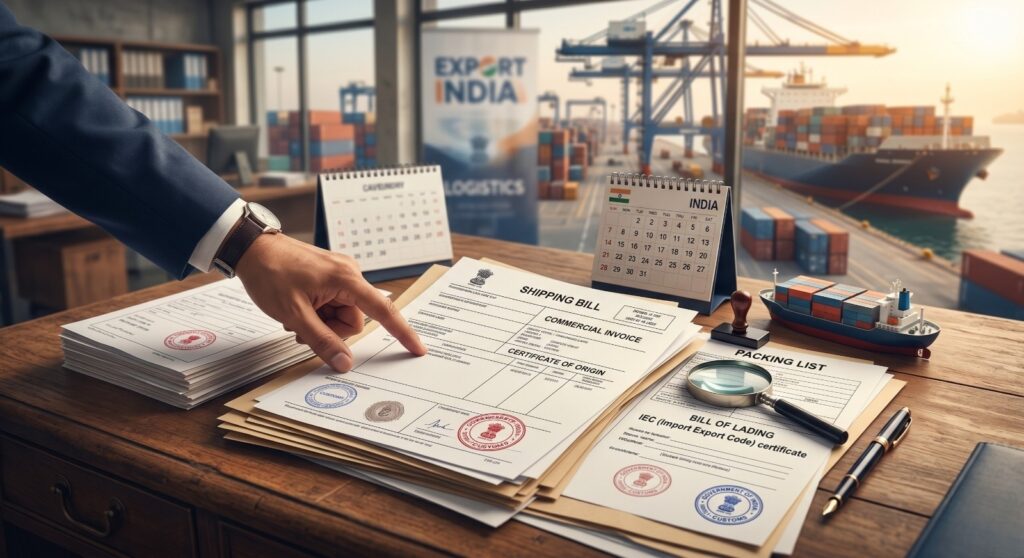
When a shipment leaves India, it must be accompanied by a specific set of documents — without them, customs clearance fails, goods get held at the port, and payment can be delayed or blocked. Getting your paperwork right is not optional; it is the foundation of every successful export transaction.
This guide covers all the export documents required in India — from the fundamental Commercial Invoice to the specialist Phytosanitary Certificate — explaining what each document is, why it is needed, who issues it, and in which situations it applies.
What’s in this guide
- Why export documents matter
- Master checklist at a glance
- Mandatory documents (every shipment)
- Financial & payment documents
- Regulatory & compliance documents
- Product-specific documents
- FTA & preferential origin documents
- Document preparation timeline
- Digital & e-documentation in 2026
- Common documentation mistakes
- Frequently asked questions
Why export documents matter
Export documentation serves four critical functions in international trade. Understanding these helps you treat paperwork not as a bureaucratic burden but as a strategic tool:
Legal compliance
Indian customs law (Customs Act 1962) and FEMA require specific documents for every export. Missing or incorrect documents can result in shipment detention, fines, or cancellation of your IEC.
Payment security
Under a Letter of Credit, the bank releases payment only against a precise set of documents. A single discrepancy — even a typo — can block payment worth lakhs of rupees.
Customs clearance
Both Indian export customs and the destination country’s import customs require specific documents to release goods. Incomplete documentation is the #1 cause of port delays.
Scheme benefits
Claiming RoDTEP, EPCG duty drawback, or GST refunds requires correct export documentation. Without the right paperwork filed on ICEGATE, you lose valuable incentives worth 2–5% of export value.
Master checklist: all export documents at a glance
Use this table as your quick-reference checklist. Documents are grouped by category and requirement status.
| # | Document | Issued by | Required when |
|---|---|---|---|
| ● Mandatory — every shipment | |||
| 01 | Commercial Invoice | Exporter | All shipments |
| 02 | Packing List | Exporter | All shipments |
| 03 | Shipping Bill | Indian Customs / ICEGATE | All shipments |
| 04 | Bill of Lading / Airway Bill | Shipping Line / Airline | All shipments |
| 05 | GST Invoice & LUT / IGST | Exporter / GST Portal | All shipments |
| ● Financial & payment | |||
| 06 | Letter of Credit (LC) | Buyer’s bank | LC payment terms |
| 07 | Bank Realisation Certificate (BRC/eBRC) | Exporter’s AD bank | Post-shipment / scheme claims |
| 08 | Bill of Exchange | Exporter | DP / DA payment terms |
| ● Regulatory & compliance | |||
| 09 | Certificate of Origin (CoO) | FIEO / EPC / Customs | FTA countries, buyer demand |
| 10 | Inspection Certificate | SGS / BV / Intertek / EIA | Buyer / destination requirement |
| 11 | Insurance Certificate | Insurance company | CIF / CIP Incoterms |
| ● Product-specific documents | |||
| 12 | FSSAI Export Certificate | FSSAI | Food & beverage exports |
| 13 | Phytosanitary Certificate | NPPO (State Agri. Dept.) | Plants, seeds, grains, agri |
| 14 | Health Certificate | EIC / MPEDA / Agri. dept. | Marine products, meat, dairy |
| 15 | Drug Regulatory Approval | CDSCO | Pharmaceutical exports |
| 16 | Fumigation Certificate | Accredited fumigators | Wooden packaging, agri goods |
| 17 | MSDS / Dangerous Goods Declaration | Exporter / Manufacturer | Chemicals, hazmat, batteries |
| 18 | RCMC (EPC Membership) | Export Promotion Council | Scheme benefits & incentives |
Mandatory documents: required for every shipment
These five documents are non-negotiable — every single export shipment from India requires them, regardless of product, value, or destination.
Commercial Invoice
Mandatory Prepared by: ExporterThe Commercial Invoice is the primary trade document — a formal request for payment from the exporter to the importer. It describes the goods, their value, the parties involved, and the terms of sale. Indian and destination customs use it to assess import duties.
Must include:
⚠ Key tip: The description, quantity, and value on the Commercial Invoice must match exactly with the Packing List and Shipping Bill. Any discrepancy causes customs delay.
Packing List
Mandatory Prepared by: ExporterThe Packing List is a detailed inventory of the shipment. It complements the Commercial Invoice by providing physical details of every package — dimensions, weight, contents per box, and serial numbers. Customs officers and freight handlers use it to physically verify the shipment.
Shipping Bill
Mandatory Issued by: Indian Customs (ICEGATE)The Shipping Bill is India’s most critical export document — it is the primary customs clearance document without which no goods can legally leave India. It is filed electronically on ICEGATE (icegate.gov.in) by the exporter’s Customs House Agent (CHA) and approved by the Customs department.
💡 Pro tip: The Shipping Bill number and date are the key references for all post-shipment scheme benefits (RoDTEP, GST refund). File it correctly — errors cannot be amended once the ship departs.
Bill of Lading (B/L) & Airway Bill (AWB)
Mandatory Issued by: Shipping line / AirlineThe Bill of Lading (for sea shipments) or Airway Bill (for air shipments) is a document of title — it is the receipt of goods by the carrier, a contract of carriage, and a document of title to the goods. Whoever holds the original B/L has ownership of the goods.
GST Invoice & Letter of Undertaking (LUT)
Mandatory Filed on: GST PortalExports from India are zero-rated under GST, meaning no GST is charged on export invoices. However, you must either file a Letter of Undertaking (LUT) on the GST portal before the first shipment of each financial year to export without paying IGST, or pay IGST upfront and claim a refund later. Filing LUT is the simpler and faster option that all regular exporters should use.
LUT Filing: Login to GST portal → Services → User Services → Furnish LUT. File before April 1 each financial year. Once accepted, you can export without paying IGST on all shipments that year. The LUT reference number must appear on your export invoices.
Financial & payment documents
These documents are tied to how you receive payment and prove that foreign exchange has been realised — both requirements under RBI’s FEMA regulations.
Letter of Credit (LC)
LC payment transactionsAn LC is a guarantee from the buyer’s bank to pay the exporter once a specified set of documents are presented that comply exactly with the LC’s terms. It is the safest payment instrument for new export relationships. Under an LC, payment is guaranteed by the issuing bank — not the buyer.
LC compliance tip: Read the LC before shipment. Every detail — product description, quantity, port names, expiry dates — must match exactly. Even punctuation differences between the LC and your documents can cause a discrepancy and block payment. Your bank’s trade finance team should review your documents against the LC before presentation.
Bank Realisation Certificate (BRC / e-BRC)
Post-shipment proofThe BRC (now called e-BRC — electronic Bank Realisation Certificate) is issued by your Authorised Dealer (AD) bank once foreign exchange payment is received and credited to your account. It proves that export proceeds have been realised, as required by FEMA. The e-BRC is uploaded by your bank to the DGFT portal and is mandatory for claiming RoDTEP scrips, duty drawback, and RCMC renewal.
Bill of Exchange
DP / DA payment termsA Bill of Exchange (B/E) is a written payment order from the exporter instructing the buyer (or the buyer’s bank) to pay a specified amount on a specified date. Used with Documents Against Payment (DP) and Documents Against Acceptance (DA) payment structures, where the buyer pays or accepts the bill in exchange for shipping documents.
Regulatory & compliance documents
Certificate of Origin (CoO)
FTA countries & buyer demand Issued by: FIEO / EPC / CustomsA Certificate of Origin is an official document certifying that the goods were produced, manufactured, or processed in India. It is required by the importing country’s customs to determine eligibility for FTA preferential duty rates, apply anti-dumping rules, or comply with import regulations.
Standard CoO confirming Indian origin. Issued by FIEO, Chamber of Commerce, or Export Promotion Councils. Required even where no FTA exists, as many buyers need it to clear their customs.
Required to claim FTA duty concessions (e.g. UAE CEPA, ASEAN FTA, India–Japan CEPA). Each FTA has its own specific CoO format. Issued by the designated authority (varies per FTA).
💡 Cost & time: Non-preferential CoO costs ₹200–500 and takes 1–2 days. Preferential CoO for FTA schemes takes 2–5 days and may require declaration of Rules of Origin compliance. Apply in advance — do not wait until the shipment is ready.
Inspection Certificate
Buyer / destination requirementAn Inspection Certificate is issued by an accredited third-party inspection agency (SGS, Bureau Veritas, Intertek, CRISIL) confirming that the goods meet specified quality, quantity, and condition standards. Many buyers, especially in the EU, US government contracts, and commodity trades, mandate this. For certain goods (e.g. engineering equipment, chemicals), the Export Inspection Agency (EIA) under DPIIT may issue the certificate.
Insurance Certificate
CIF / CIP IncotermsWhen selling on CIF (Cost, Insurance and Freight) or CIP (Carriage and Insurance Paid To) terms, the seller is required to arrange and provide cargo insurance. The Insurance Certificate confirms cover for the consignment. Under Incoterms 2020, CIP requires Institute Cargo Clause A (all-risk) coverage, while CIF requires only minimum Clause C cover. Issued by Indian insurers (New India Assurance, National Insurance, etc.) or approved international brokers.
Product-specific documents
Depending on what you export, additional regulatory documents are mandatory. Here are the most important product-specific documents:
FSSAI Export Certificate
Food & beverage exportsIssued by the Food Safety and Standards Authority of India (FSSAI) for all food product exports. The exporter must be FSSAI-registered or FSSAI-licensed, and the export certificate confirms compliance with Indian food safety standards. Some destination countries also require a Sanitary/Phytosanitary (SPS) certificate issued in a specific format.
Applies to: Processed foods, snacks, spices, tea, coffee, rice, bakery goods, beverages, dairy products, and any food item exported for human consumption.
Phytosanitary Certificate
Plants, seeds, grains, fresh produceA Phytosanitary Certificate is issued by India’s National Plant Protection Organisation (NPPO) — the Directorate of Plant Protection, Quarantine and Storage (DPPQS), under the Ministry of Agriculture — confirming that plant products are free from pests and diseases. It is required by the destination country’s plant quarantine authorities.
Applies to: Basmati rice, wheat, maize, pulses, fresh fruits, vegetables, seeds, live plants, cut flowers, tobacco, cotton, and any plant-based agricultural commodity.
Health Certificate / EIC Certificate
Marine products, meat, dairyFor seafood and marine product exports, the Export Inspection Council of India (EIC) and MPEDA (Marine Products Export Development Authority) issue health certificates confirming the product meets importing country standards. The EU, USA, Japan, and most developed markets require EIC health certificates for Indian seafood. MPEDA-approved processing plants are a prerequisite.
Drug Regulatory & GMP Certificates
Pharmaceutical exportsPharmaceutical exporters require several regulatory documents: a Certificate of Pharmaceutical Product (CoPP) from CDSCO confirming WHO-GMP compliance, Free Sale Certificate for OTC products, Analytical Certificate (Certificate of Analysis/CoA) for each batch, and destination-specific approvals (US FDA for USA, CE mark for EU, TGA for Australia). CDSCO’s online portal handles most applications.
Fumigation Certificate (ISPM 15)
Wooden packaging & agri commoditiesUnder ISPM 15 (International Standards for Phytosanitary Measures), all wooden packaging material (pallets, crates, dunnage) used in international shipments must be treated (heat treatment or methyl bromide fumigation) and marked with the IPPC logo. A Fumigation Certificate from an accredited fumigator proves compliance. Most countries — especially the EU, USA, Australia, and China — enforce this strictly. Non-compliance results in shipment rejection at the destination port.
MSDS & Dangerous Goods Declaration
Chemicals, hazardous goods, batteriesA Material Safety Data Sheet (MSDS) or Safety Data Sheet (SDS) provides chemical safety information. For dangerous goods under IMDG (sea) or IATA (air) regulations, a Dangerous Goods Declaration (DGD) signed by a certified DG shipper is required. This covers hazardous chemicals, flammable goods, lithium batteries, aerosols, and infectious substances. Missing DG documentation can result in criminal penalties and shipment rejection.
RCMC — Registration-cum-Membership Certificate
Scheme benefits & EPC membershipThe RCMC is issued by the relevant Export Promotion Council (EPC) or commodity board and certifies your registration as an exporter in that sector. It is required to claim RoDTEP benefits, EPCG licences, MAI/MDA scheme funding, and participation in government-subsidised trade fairs. Apply through your sector’s EPC (APEDA for agri, PHARMEXCIL for pharma, FIEO for general, etc.).
FTA & preferential origin documents
If your buyer is in a country that has an FTA with India, presenting the right origin document allows them to import your goods at a reduced or zero duty rate — a direct competitive advantage for you as a supplier.
Form A (GSP)
Generalised System of Preferences CoO for exports to EU, Canada, and other GSP-granting countries. Issued by designated agencies. Enables 0% or reduced duty for eligible Indian products.
Form AI (ASEAN–India FTA)
For exports to ASEAN countries (Thailand, Vietnam, Indonesia, Malaysia, etc.) under the India–ASEAN FTA. Issued by Export Inspection Council or Customs. Valid for 12 months.
Form ISAI (India–Japan CEPA)
Origin certificate for exports to Japan under the India–Japan CEPA. Issued by FIEO or authorized agencies. Enables preferential duty access for qualifying Indian products in Japan.
Certificate of Origin — UAE CEPA
For exports to UAE under the CEPA. Issued by FIEO, Export Promotion Councils, or Customs. Enables 0% duty on 97%+ of Indian goods exported to UAE. Most valuable FTA CoO in 2026.
AIFTA Form (India–Australia ECTA)
Origin certificate for India–Australia Economic Cooperation and Trade Agreement. Issued by FIEO / authorised issuing authorities. India–Australia ECTA covers textiles, pharma, agri, and more at reduced rates.
💡 Self-certification (approved exporters)
Under some newer FTAs, India is piloting “Approved Exporter” schemes where exporters can self-certify origin on their invoice without applying to an EPC. Check the DGFT portal for the latest approved exporter schemes.
Document preparation timeline
Timing matters. Many documents must be applied for well in advance of the shipment date. Here is the sequence to follow:
Before order confirmation
Ensure IEC is active, GSTIN is registered, LUT is filed for the current financial year, RCMC is valid, and any sector-specific licences (FSSAI, CDSCO) are in place. These are standing requirements — not per-shipment.
3 weeks before shipment
Apply for Certificate of Origin (FTA or non-preferential), Phytosanitary Certificate (if applicable), FSSAI Export Certificate, Health Certificate (marine/food), and Inspection Certificate. These have lead times of 3–10 working days.
1 week before shipment
Prepare Commercial Invoice and Packing List. Book freight (get Bill of Lading draft / booking confirmation). Arrange fumigation of wooden packaging. Prepare MSDS / DG Declaration if applicable. Submit pre-shipment documents to your CHA.
Shipment day
CHA files Shipping Bill on ICEGATE. Customs examines / LEO (Let Export Order) granted. Goods loaded. Bill of Lading issued by shipping line. Original documents couriered to buyer (or telex released).
Post-shipment
Once payment is received, your AD bank issues e-BRC. File for RoDTEP credit on ICEGATE. Submit GST refund claim on GST portal (if IGST paid). Keep all documents on file for 5 years for audit purposes.
Digital & e-documentation in India 2026
India’s export documentation system has undergone a major digital transformation. In 2026, most documents are filed, processed, or verified online. Here is the current state of digital documentation:
ICEGATE (icegate.gov.in)
India’s customs EDI system. All Shipping Bills filed here. Provides LEO (Let Export Order), tracks customs status, handles RoDTEP credit transfers, and links to GSTN for refund processing.
DGFT Portal (dgft.gov.in)
Apply for IEC, RCMC, and EPCG licences. View and manage RoDTEP scrips, e-BRC, and export scheme applications. IEC amendments and profile updates done here.
GST Portal (gst.gov.in)
File LUT for zero-rated exports, claim IGST refunds (auto-processed when Shipping Bill and GSTR-1 data match), and reconcile export invoices with GST returns.
eSCRIP (RoDTEP)
RoDTEP credit is issued as electronic scrips on ICEGATE. Exporters can view, transfer, and use scrips to pay customs duty or sell them to importers — all digitally.
e-CoO (eCooP portal)
DGFT’s eCooP platform allows digital application and issuance of non-preferential Certificates of Origin. Reduces processing time from days to hours for standard CoOs.
e-BRC (Bank portal)
Banks upload e-BRCs to DGFT’s portal within 21 days of payment realisation. Exporters can view e-BRCs on the DGFT portal and use them for scheme applications without a physical certificate.
Common documentation mistakes that cost exporters money
Mismatch between Commercial Invoice and Packing List: The description, quantity, and value on these two documents must be identical. Any discrepancy causes customs to put the shipment on hold and delays Let Export Order. Your CHA should cross-check these before filing.
Not filing LUT before the financial year starts: If you forget to file your GST Letter of Undertaking before April 1, your export invoice will not be zero-rated and you will have to pay IGST upfront. Claiming a refund can take 3–6 months. Set a reminder every year.
Applying for CoO too late: Certificate of Origin applications should be started 1–2 weeks before the shipment, especially for FTA-specific CoOs which may require Rules of Origin documentation. A last-minute CoO application causes shipment delays or forces you to export without FTA benefit.
Wrong HS code on the Shipping Bill: The HS code determines export duty, RoDTEP rate, and the applicable schemes. An incorrect HS code means you either overpay duty or under-claim benefits. Always verify the 8-digit HS code with your CHA before filing.
Missing fumigation certificate for wooden packaging: ISPM 15 compliance is strictly enforced at almost all destination ports. A missing or non-compliant fumigation certificate leads to goods being rejected at destination — at your cost.
Not maintaining document records for 5 years: Indian law (Customs Act and FEMA) requires all export documents to be retained for a minimum of 5 years. Audit notices from DGFT or Customs can arrive years after shipment. Missing records = no defence.
Frequently asked questions
What documents are required for export from India?
Every export shipment requires five mandatory documents: Commercial Invoice, Packing List, Shipping Bill (filed on ICEGATE), Bill of Lading or Airway Bill, and GST Invoice with LUT. Additional documents are needed based on product and destination — for example, a Phytosanitary Certificate for agricultural goods, FSSAI Export Certificate for food products, Certificate of Origin for FTA countries, and Drug Regulatory certificates for pharmaceuticals.
What is a Shipping Bill in India?
A Shipping Bill is India’s primary export customs clearance document, filed electronically on ICEGATE by the exporter’s Customs House Agent (CHA). Without a Shipping Bill approved by customs — called the Let Export Order (LEO) — no goods can legally leave India. The Shipping Bill is also the trigger document for RoDTEP credits and GST refunds, so accuracy is critical.
Is IEC mandatory for all exports from India?
Yes, the Import Export Code (IEC) is mandatory for all commercial exports and imports. It is a 10-digit code issued by DGFT (dgft.gov.in) for a one-time fee of ₹500, typically issued within 1–3 working days. There is no renewal required. It must be quoted on all Shipping Bills, export invoices, and bank documents. The only exceptions are personal-use imports below a threshold and certain government goods.
Is GST applicable on exports from India?
Exports are zero-rated under Indian GST — you do not charge GST on export invoices. However, you must file a Letter of Undertaking (LUT) on the GST portal before each financial year (before April 1) to export without paying IGST upfront. Without an LUT, you must pay IGST on the export invoice and claim a refund later — a process that can take 3–6 months.
What is the role of a CHA in export documentation?
A Customs House Agent (CHA) is a licensed professional who files the Shipping Bill on ICEGATE on behalf of the exporter, liaises with Indian Customs for the Let Export Order, coordinates with the port and shipping line, and ensures all documentation is compliant with the Customs Act. Hiring a licensed CHA is essential for most exporters — they are legally responsible for the accuracy of customs filings and can prevent costly errors.
Need help with your export documentation?
From filing your Shipping Bill on ICEGATE to getting the right Certificate of Origin for your FTA market — get expert guidance and never miss a document again.
Get documentation support →