
⚡ Quick Answer
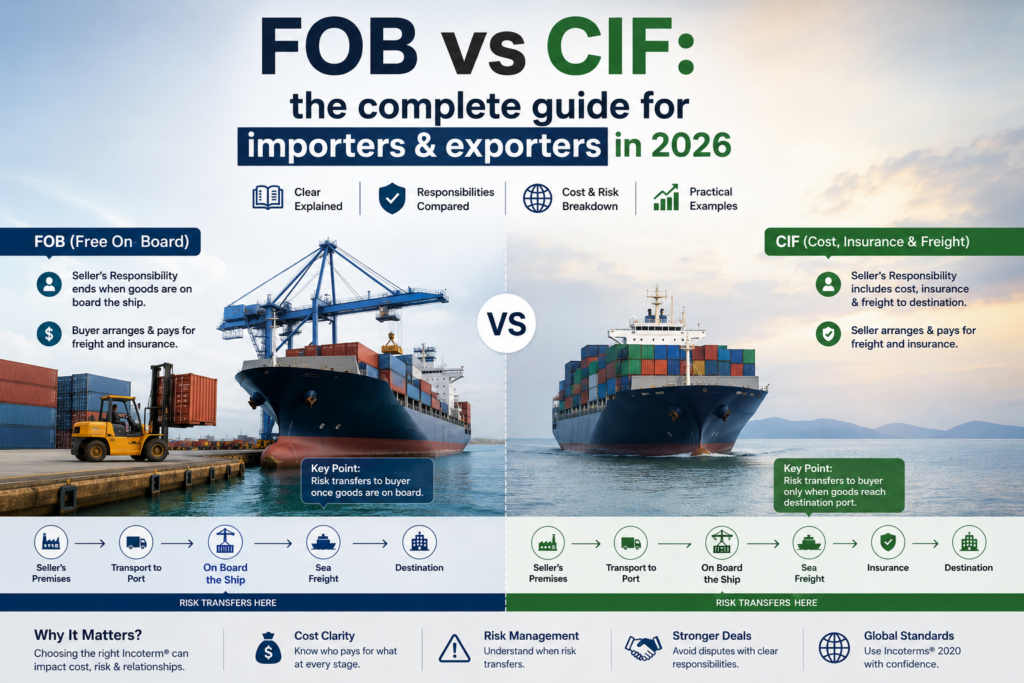
FOB (Free On Board): The seller’s responsibility ends when goods are loaded on the vessel at the origin port. The buyer arranges and pays for freight and insurance for the main journey.
CIF (Cost, Insurance & Freight): The seller pays for freight and arranges minimum insurance to the destination port. But — crucially — risk still transfers to the buyer when goods are loaded at origin, just like FOB.
The #1 confusion: Under CIF, the seller pays the freight but the buyer bears the risk during the voyage. This split between cost and risk is what trips up most traders.
FOB and CIF are two of the most commonly used trade terms in international commerce — and two of the most misunderstood. Get them wrong and you could end up paying for goods that were lost at sea, missing out on freight savings, or having your Letter of Credit rejected by the bank.
This guide explains both Incoterms in plain language, compares them across every dimension that matters — cost, risk, insurance, customs, and payment — and tells you exactly when to use which term for different situations.
What’s in this guide
- What is FOB — explained simply
- What is CIF — explained simply
- Visual journey: FOB vs CIF step by step
- FOB vs CIF: full comparison table
- FOB vs CIF for Indian exporters
- FOB vs CIF for importers/buyers
- FOB vs CIF in LC transactions
- Pricing example: a real calculation
- When to use FOB vs CIF
- Common mistakes to avoid
- Frequently asked questions
Visual journey: FOB vs CIF step by step
Here is a side-by-side visual of who does what at every stage of a sea shipment under both terms. Blue = seller’s responsibility. Red = buyer’s responsibility.
| Stage of shipment | FOB | CIF |
|---|---|---|
| 🏢 Packing & preparation | 🟩 SELLER | 🟩 SELLER |
| 🚕 Inland transport to origin port | 🟩 SELLER | 🟩 SELLER |
| 🏴 Export customs clearance | 🟩 SELLER | 🟩 SELLER |
| 🚢 Loading on board vessel at origin | 🟩 SELLER | 🟩 SELLER |
| ▼ RISK TRANSFERS TO BUYER AT THIS POINT — UNDER BOTH FOB AND CIF ▼ | ||
| 🚢 Booking & paying freight | 🔴 BUYER | 🟩 SELLER |
| 📋 Arranging cargo insurance | 🔴 BUYER | 🟩 SELLER (min.) |
| 🛠 Risk of loss/damage at sea | 🔴 BUYER | 🔴 BUYER |
| ⛴ Destination port charges | 🔴 BUYER | 🔴 BUYER |
| 📋 Import customs clearance | 🔴 BUYER | 🔴 BUYER |
| 🏭 Import duties & taxes | 🔴 BUYER | 🔴 BUYER |
The key takeaway from this table: FOB and CIF are identical in terms of risk. The only difference is who pays for freight and who arranges insurance. Under CIF, the seller pays freight as a service to the buyer — but the buyer still bears the risk if anything goes wrong at sea.
FOB vs CIF: the complete comparison
| Criteria | 🚢 FOB | 📋 CIF |
|---|---|---|
| Full name | Free On Board | Cost, Insurance & Freight |
| Mode of transport | Sea & inland waterway only | Sea & inland waterway only |
| Risk transfer point | On board at origin port | On board at origin port |
| Who pays ocean freight | BUYER | SELLER |
| Who arranges insurance | BUYER | SELLER (min. only) |
| Insurance coverage level | Buyer’s choice (recommend Clause A) | Clause C only (minimum) |
| Seller’s delivery point | Origin port (ship’s deck) | Named destination port |
| Export customs | SELLER | SELLER |
| Import customs | BUYER | BUYER |
| Import duties | BUYER | BUYER |
| Who controls freight choice | BUYER (better leverage) | SELLER |
| Who makes insurance claim at sea | BUYER (their policy) | BUYER (seller’s policy, buyer’s risk) |
| Seller’s invoice price | Lower (excludes freight/insurance) | Higher (includes freight/insurance) |
| Used for containers? | Not recommended ⚠ | Not recommended ⚠ |
| Preferred for containers | Use FCA instead | Use CIP instead |
FOB vs CIF for Indian exporters: which is better?
As an Indian exporter, the choice between FOB and CIF affects your workload, your invoice value, your cash flow, and your risk exposure. Here is the honest breakdown:
🚢 FOB — Why Indian exporters prefer it
📋 CIF — Why Indian exporters sometimes prefer it
Indian exporter verdict: FOB is generally recommended for Indian exporters unless you have strong freight rate relationships and understand the obligations. The risk of underinsured CIF claims, freight rate disputes, and LC complications makes FOB the cleaner, safer choice for most exporters.
FOB vs CIF for importers and buyers
If you are importing from India, here is what each term means for your total landed cost, control, and risk:
🚢 Why importers prefer FOB
📋 Why some importers choose CIF
💡 Importer tip on customs duty: India calculates import duty on CIF value (cost + insurance + freight). So if you are importing into India, a supplier quoting CIF gives you a higher customs duty base than FOB. For imports into India, always request FOB pricing to minimise your customs duty assessment.
FOB vs CIF in Letter of Credit (LC) transactions
When payment is made via Letter of Credit, the choice between FOB and CIF has critical implications for the documents you must present to get paid. A single discrepancy between the LC terms and your documents can block your entire payment.
📄 Documents required under FOB LC
📄 Documents required under CIF LC
CIF LC trap: Under a CIF LC, the insurance certificate must be for at least 110% of the CIF invoice value (as required by UCP 600 Article 28). The insurance must be endorsed in blank (so the buyer can claim) and must cover the risks specified in the LC. If you arrange Clause C insurance but the LC requires Clause A — the documents are discrepant and payment is blocked. Always read the LC’s insurance clause before shipping.
Pricing example: FOB vs CIF on a real shipment
Let’s use a real-world example: an Indian garment exporter shipping 500 units of cotton kurtas to a buyer in the UK. Product cost: ₹5,00,000 (~$6,000).
| Cost element | FOB | CIF |
|---|---|---|
| Product cost (ex-factory) | $6,000 | $6,000 |
| Inland transport to JNPT | $120 | $120 |
| Origin port handling & documentation | $180 | $180 |
| FOB value (seller’s invoice) | $6,300 | — |
| Ocean freight JNPT → Felixstowe UK | Buyer: $820 | Seller: $820 |
| Cargo insurance (Clause C, 110% CIF) | Buyer arranges | Seller: $42 |
| CIF value (seller’s invoice) | — | $7,162 |
| UK customs duty base (assessed on CIF value) | $6,300 (lower) | $7,162 (higher) |
| Total buyer’s landed cost (pre duty/VAT) | $7,120 | $7,162 |
What this example shows: The total landed cost is similar under both terms. The real differences are: (1) who arranges freight, (2) who controls insurance quality, and (3) the customs duty base in the importing country. If UK assesses duty on CIF value, the buyer pays slightly more duty under CIF. In countries like India that assess on CIF, this difference becomes very significant.
When to use FOB vs CIF: a practical decision guide
🚢 Use FOB when…
📋 Use CIF when…
Critical warning: FOB and CIF are NOT recommended for containerised shipments
This is the most important point in this entire guide. Both FOB and CIF were designed for bulk cargo loaded directly onto ships. In containerised trade (FCL or LCL), goods are handed to the freight forwarder at the container freight station (CFS) — not loaded “on board” a vessel. This creates a risk gap: who bears the risk between the CFS and the vessel?
FCA (Free Carrier) transfers risk when goods are handed to the carrier at the named place — the CFS or seller’s premises. This is correct for container trade.
CIP (Carriage and Insurance Paid To) requires Clause A (all-risks) insurance — a significant improvement over CIF’s minimum Clause C. Use CIP for containerised shipments.
Common FOB and CIF mistakes to avoid
⚠ Using FOB/CIF for container shipments
The most common mistake in Indian trade. Container goods should use FCA (instead of FOB) and CIP (instead of CIF). Using FOB or CIF creates an uninsured risk gap between the container freight station and the vessel.
⚠ Not naming a specific port
“FOB India” or “CIF USA” are not valid terms. Always name a specific port: “FOB Nhava Sheva (JNPT)” or “CIF Los Angeles”. Vague location = vague risk transfer = disputes.
⚠ Thinking CIF means lower risk for the seller
Many sellers mistakenly believe that by arranging insurance under CIF, they protect themselves. They don’t. The seller still transfers risk at loading. The insurance policy benefits the buyer, not the seller.
⚠ CIF insurance Clause C vs Clause A confusion
CIF requires only minimum Clause C insurance, which excludes many common loss causes (piracy, theft, water damage). Buyers under CIF should always arrange supplementary Clause A (all-risks) cover. Never assume CIF insurance is adequate.
⚠ Not specifying the Incoterms edition
Always write “Incoterms® 2020” in your contract. The 2010 and 2020 versions have differences. Unspecified edition leads to disputes about which rules govern the transaction.
⚠ Ignoring customs duty base difference
Countries like India assess import duty on CIF value. Choosing CIF vs FOB can significantly affect your customs duty bill. Indian importers should always compare both on a total landed cost basis before agreeing terms.
Frequently asked questions
What is the main difference between FOB and CIF?
The main difference is who pays for freight and arranges insurance. Under FOB, the buyer pays freight and arranges insurance from the origin port. Under CIF, the seller pays freight and arranges minimum insurance to the destination port. However — critically — risk transfers at the same point under both terms: when goods are loaded on board the vessel at the origin port. CIF’s extra services (freight & insurance) are for the buyer’s convenience, not the seller’s protection.
Which is better for the seller — FOB or CIF?
FOB is generally better for sellers (exporters) because it ends their responsibility at the origin port, eliminates freight rate risk, reduces LC document complexity, and is preferred by large international buyers in the USA and EU. CIF can be used to earn a freight margin if you have strong carrier relationships, but adds freight booking obligations, insurance requirements, and potential LC discrepancy risks.
Does risk transfer at the same point under FOB and CIF?
Yes — and this surprises many traders. Under both FOB and CIF, risk transfers to the buyer when goods are placed on board the vessel at the origin port. Under CIF, the seller pays the freight and arranges insurance, but if goods are lost or damaged during the sea voyage, the buyer bears the loss and makes the insurance claim. The seller has already discharged their risk obligation at the loading port.
Should I use FOB or CIF for container shipments?
Neither. Both FOB and CIF were designed for bulk cargo, not containerised shipments. For container trade (FCL or LCL), use FCA instead of FOB, and CIP instead of CIF. These terms correctly transfer risk when goods are handed to the freight forwarder at the container freight station — not at the vessel’s rail, which may be days later and in a location the seller cannot verify.
How does FOB vs CIF affect import duty in India?
India assesses import customs duty on the CIF value (cost + insurance + freight) of imported goods. Under FOB, your customs duty base is lower because freight and insurance are not included in the declared import value. Under CIF, the duty base is higher because freight and insurance are included. For imports into India, always request FOB pricing from your foreign suppliers to minimise your customs duty and GST (IGST) assessment.
What documents are needed in a CIF LC that are not needed in a FOB LC?
Under a CIF Letter of Credit, the seller must additionally present an Insurance Certificate or Insurance Policy endorsed in blank, covering at least 110% of the CIF invoice value for the risks specified in the LC. If the LC requires all-risks (Clause A) coverage but the seller arranged only minimum (Clause C) insurance, the documents are discrepant and payment will be blocked by the bank. Always read the insurance clause of any CIF LC before arranging your insurance policy.
Need help choosing the right Incoterms?
Whether you’re quoting FOB Mumbai to a US buyer or arranging CIF Rotterdam for a European deal — getting your trade terms right protects your margins, your payment, and your relationship.
Get Incoterms guidance →