
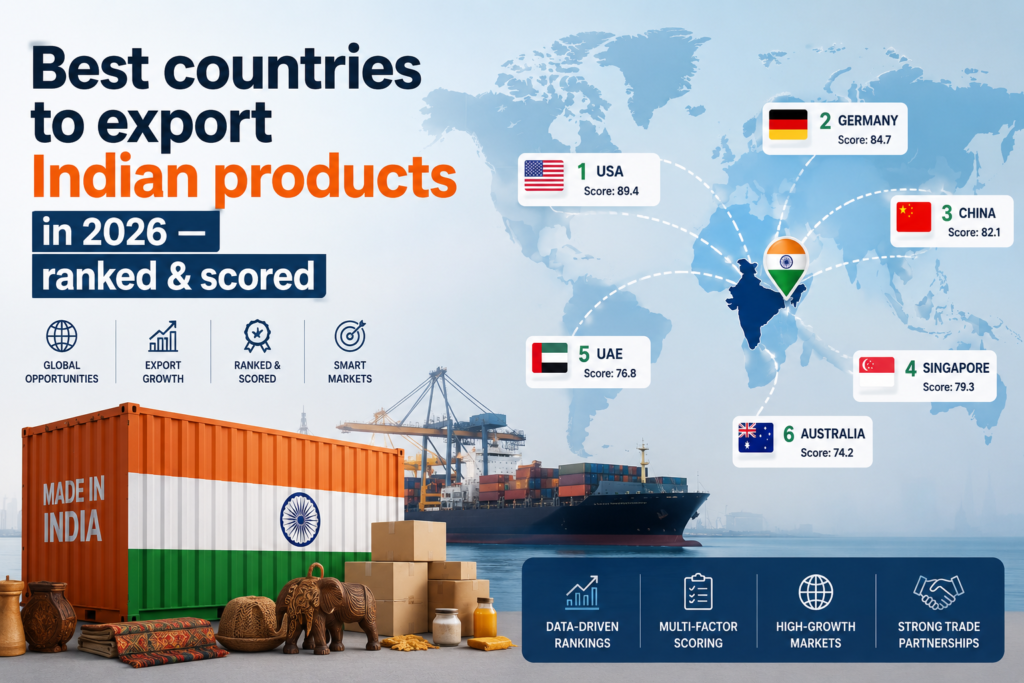
India’s $776 billion+ export engine runs on smart market choices. But most exporters either target the same overcrowded markets or chase the wrong destinations — wasting time, money, and opportunities.
This guide does something different: it scores each country out of 10 across five criteria that actually determine export success — FTA tariff access, import demand for Indian goods, compliance & entry complexity, payment & risk safety, and 2026 growth potential. Use these scorecards to find the market that fits your product and business.
How each country is scored (out of 10)
Markets covered in this guide
United Arab Emirates
The UAE is the undisputed #1 choice for Indian exporters in 2026. The India–UAE CEPA — the most powerful bilateral trade agreement India has ever signed — grants zero duty on 97% of Indian goods. Before CEPA, every exporter paid 5% UAE customs duty. Today, on a ₹1 crore shipment, that’s ₹5 lakhs saved immediately on every order.
But the UAE is more than a direct market. Dubai’s Jebel Ali Free Zone is the world’s largest re-export hub, giving Indian goods indirect access to 140+ countries across the Middle East, Africa, and South Asia. No other single market multiplies your export reach this way.
📄 Top Indian products in demand
Entry action: Get a UAE CEPA Certificate of Origin from FIEO or your Export Promotion Council. This single document unlocks the 0% duty benefit. Also register on the Dubai Chamber’s B2B matchmaking portal and explore JAFZA free zone setup for a regional hub.
Singapore
Singapore is Asia’s most open economy, with near-zero import tariffs on almost all goods, world-class logistics infrastructure, and a rule-of-law business environment that gives Indian exporters one of the most frictionless entry experiences on earth. The India–Singapore CECA covers goods, services, and investment — and Indian IT firms, professional services companies, and financial sector businesses use Singapore as their entire Southeast Asian headquarters.
As the logistics and financial hub of 680-million-person ASEAN, goods entering Singapore get redistributed across Thailand, Vietnam, Indonesia, Malaysia, and the Philippines. Think of Singapore not just as a destination but as your ASEAN distribution base.
Entry action: Register on the Singapore Business Federation’s buyer connect platform. For IT and services, establish a Singapore entity (takes 1–2 days online). Use the CECA’s services chapter provisions to bring Indian professionals to Singapore for project delivery.
Australia
Australia is India’s fastest-growing major export market since the ECTA came into force in December 2022. The deal reduced tariffs on pharma from 4–5% to 0%, textiles from 5% to 0%, cotton yarn from 5% to 0%, and gems from 5% to 0%. This is a direct and immediate competitive advantage over non-FTA suppliers including China, Bangladesh, and Vietnam.
With 700,000+ Indian diaspora, English-language business culture, and growing taste for Indian food, fashion, and healthcare products, Australia offers a uniquely welcoming market. Payment defaults are rare — ECGC rates Australia as a very low-risk destination.
Entry action: Apply for AIFTA Certificate of Origin for Australia ECTA from FIEO. Register with Austrade’s India Business Council. For food exports, get FSANZ recognition. For pharma, TGA (Therapeutic Goods Administration) registration is required.
United Kingdom
The UK is the most watched market of 2026. The India–UK FTA, in its final negotiations stage as of April 2026, will be a watershed moment. It is expected to eliminate the current 9.6–12% garment tariff, reduce duties on gems & jewellery (currently 2.5–4%), and ease movement of Indian IT professionals. Industry bodies estimate the FTA could add $10–15 billion in annual Indian exports to the UK.
The UK’s 1.8 million Indian diaspora creates organic demand for Indian food, textiles, jewellery, and cultural products. Post-Brexit, the UK is actively building new trade partnerships — and India is its most important developing-world priority. Start building UK relationships now to be first when the FTA drops.
United States of America
The USA is India’s most important export market by pure volume and will remain so in 2026. The sheer size of the US economy — $27+ trillion GDP — ensures massive, ongoing demand for Indian pharmaceuticals (India supplies 40% of US generic drugs), IT services, engineering goods, textiles, and gems. Despite no FTA, the India–US trade relationship is irreplaceable in scale.
The complexity is real: US market entry requires significant compliance investment. Pharma needs US FDA approval. Electronics must meet FCC standards. Food products require FDA registration. But the rewards — the world’s highest-paying market — fully justify the compliance investment for mature exporters.
2026 watch: A limited India–US sectoral trade agreement on pharma, IT products, and engineering goods is under active discussion. If concluded, it could give Indian exporters their first tariff advantage in the US market. Monitor DGFT and DPIIT announcements closely through 2026.
More high-value markets: Saudi Arabia, Germany, Bangladesh & Canada
Saudi Arabia & GCC
Saudi Vision 2030’s massive infrastructure boom is creating enormous demand for Indian construction materials, engineering goods, and food products. The GCC collectively imports $60B+ from India. Top sectors: petroleum products, rice & spices, engineering, pharma, textiles.
💡 Key opportunity: India–GCC FTA negotiations are ongoing. When concluded, it will complement the UAE CEPA to give Indian goods zero-duty access across all 6 GCC nations.
Germany & EU
Germany leads EU demand for Indian engineering goods, auto components, chemicals, and dyes. High compliance standards (CE mark, REACH, CBAM from 2026) but premium prices. The pending India–EU BTIA covers 27 nations & 450M consumers and will transform access when concluded.
⚠ 2026 alert: EU CBAM (Carbon Border Adjustment) impacts steel, aluminium & fertiliser exports. Prepare CBAM compliance documentation now.
Bangladesh & South Asia
Bangladesh is India’s largest South Asian export market — India supplies cotton yarn, fabric, machinery, and chemicals that power Bangladesh’s global RMG industry. Nepal, Sri Lanka, and Bhutan add significant volumes. Land border trade via LCS (Land Customs Stations) gives speed and cost advantages over sea.
💡 Quick win: India’s textile exporters supply Bangladesh’s garment industry. SAFTA enables preferential rates — use Land Customs Stations at Petrapole and Agartala for faster clearance.
Canada
1.8 million Indian diaspora — the world’s largest by proportion. Strong demand for Indian pharma, pulses (lentils, chickpeas), gems, textiles, and IT services. Canada–India CEPA talks are paused due to diplomatic issues but trade continues strongly. Low payment risk, English-language market.
💡 Opportunity: Indian pulses & organic food have a natural diaspora market. Indian IT companies are establishing Canadian delivery centres as a US visa alternative. Monitor CEPA talks for a potential 2026–27 breakthrough.
High-potential emerging & specialist markets
Japan
Lower volume, highest unit value per shipment. Japanese buyers pay premium prices but demand zero-defect quality and 100% on-time delivery. Top exports: engineering & auto components, marine products (Japan is India’s #2 seafood market), pharma, chemicals. CEPA active since 2011.
South Africa & Africa
India supplies 50%+ of Africa’s generic medicines. South Africa, Nigeria, Kenya, Egypt, and Tanzania are key markets. AfCFTA (54-nation free trade zone) is creating a unified $3.4 trillion market that India-based exporters can access via a single African country entry point. Massive untapped potential.
Vietnam & ASEAN
Vietnam’s booming manufacturing sector drives demand for Indian cotton yarn, machinery, pharma, and agrochemicals. The ASEAN FTA provides preferential rates. Indonesia, Thailand, and the Philippines add to the region’s attractiveness. Singapore is the natural gateway into the ASEAN bloc.
🏆 The 2026 export market leaderboard
| Rank | Country | FTA | Demand | Entry | Payment | Growth | Total |
|---|---|---|---|---|---|---|---|
| 🥇 | 🇦🇪 UAE | 10 | 9 | 10 | 9 | 10 | 9.6 |
| 🥈 | 🇸🇬 Singapore | 9 | 9 | 10 | 10 | 8 | 9.2 |
| 🥉 | 🇦🇺 Australia | 9 | 8 | 9 | 10 | 9 | 9.0 |
| 4 | 🇬🇧 UK | 8 | 9 | 8 | 10 | 9 | 8.8 |
| 5 | 🇸🇦 Saudi/GCC | 7 | 9 | 8 | 9 | 9 | 8.6 |
| 6 | 🇺🇸 USA | 6 | 10 | 6 | 10 | 8 | 8.4 |
| 7 | 🇧🇩 Bangladesh | 8 | 8 | 9 | 7 | 8 | 8.2 |
| 8 | 🇩🇪 Germany/EU | 6 | 9 | 6 | 9 | 8 | 7.8 |
| 9 | 🇨🇦 Canada | 5 | 8 | 8 | 10 | 7 | 7.8 |
| 10 | 🇯🇵 Japan | 8 | 6 | 5 | 10 | 7 | 7.6 |
| 11 | 🇻🇳 Vietnam/ASEAN | 7 | 7 | 7 | 8 | 9 | 7.6 |
| 12 | 🇿🇦 South Africa | 6 | 7 | 7 | 7 | 9 | 7.4 |
🎯 Which market is best for YOUR product?
Scores matter, but product-market fit matters more. Use this matrix to identify which market is the best match for your specific export category:
| Product category | Best market #1 | Best market #2 | FTA advantage |
|---|---|---|---|
| 💊 Pharmaceuticals | USA | South Africa / Africa | Australia ECTA (0% duty) |
| 🧵 Textiles & apparel | USA | UK (post-FTA) | Australia ECTA, UAE CEPA |
| 💎 Gems & jewellery | UAE | USA | UAE CEPA (0% duty) |
| 🌿 Spices & agri food | UAE | USA | UAE CEPA, ASEAN FTA |
| 🔧 Engineering & auto parts | Germany/EU | USA | Japan CEPA, UAE CEPA |
| 💻 IT & software services | USA | Singapore / UK | Singapore CECA |
| ⚙ Chemicals & agrochem | USA / Brazil | Germany/EU | Japan CEPA, UAE CEPA |
| 👡 Leather & footwear | Germany/Italy/EU | USA | EU BTIA (when concluded) |
| 🌿 Rice & agri commodities | UAE / Saudi Arabia | Bangladesh | UAE CEPA, SAFTA |
Frequently asked questions
Which is the best country to export Indian products in 2026?
Based on our 5-criteria scoring, the UAE ranks #1 with 9.6/10 in 2026. The India–UAE CEPA provides 0% duty on 97% of Indian goods, the UAE acts as a global re-export hub to 140+ countries, and market entry is fast and low-complexity. Singapore (9.2) and Australia (9.0) are close runners-up. For pure volume, the USA remains #1 but scores lower due to high compliance barriers and no active FTA.
Why is UAE the top-ranked market for Indian exporters?
The UAE gets a perfect 10 on FTA access, entry ease, and growth potential because: the India–UAE CEPA gives 0% duty on 97%+ of Indian goods (saving 5% on every shipment); Jebel Ali is the world’s largest re-export hub providing indirect access to 140+ countries; a 3.3 million Indian diaspora drives organic consumer demand; and payment defaults are extremely rare with strong legal enforcement.
Which market offers the biggest growth opportunity in 2026 specifically?
The UK offers the single biggest growth event of 2026 — the India–UK FTA conclusion is expected to eliminate 9.6–12% garment tariffs, reduce jewellery duties, and ease IT professional mobility, potentially unlocking $10–15B in new annual exports. For long-term structural opportunity, Africa (via South Africa, Nigeria, Kenya) driven by the 1.4-billion-person continent’s AfCFTA, is the biggest emerging story.
How do I choose the right export market for my product?
Use this 5-step approach: (1) Check import demand data for your HS code on ITC Trade Map (trademap.org) or DGFT portal; (2) verify FTA duty rates for your specific product; (3) assess compliance complexity (US FDA, EU REACH, TGA Australia, etc.); (4) check ECGC country risk rating for payment safety; (5) start with 2–3 markets max. For most new Indian exporters, UAE + Australia is the recommended starting combination — both have active FTAs, easy entry, and excellent payment safety.
Your perfect export market is waiting
Whether it’s UAE with 0% CEPA duty, Australia’s fast-growing FTA market, or the UK’s incoming FTA opportunity — the right market, right documents, and right EPC support get you trading globally within weeks.
Get personalised market guidance →