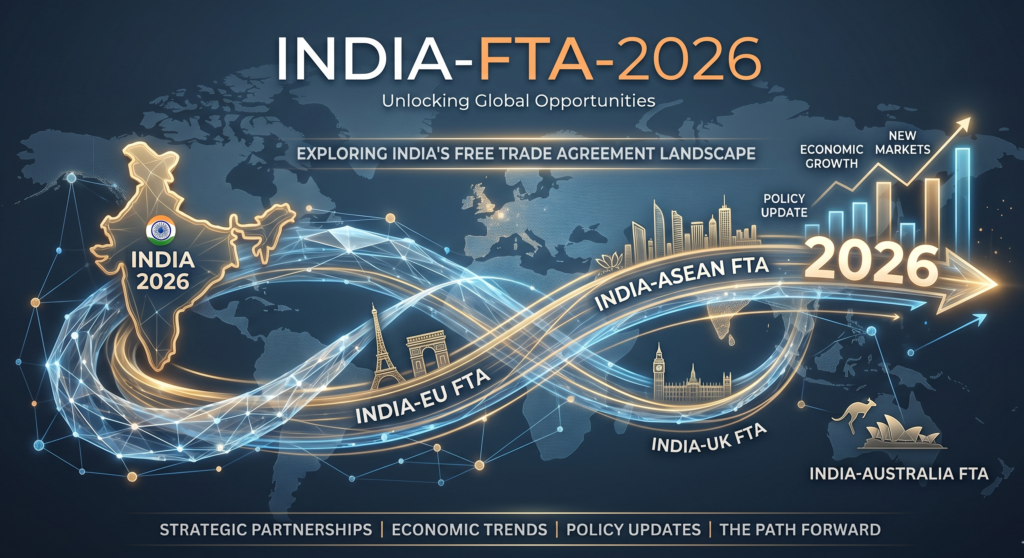
Trade Policy · India 2026
Free Trade Agreements and India in 2026: what every business must know
How India’s expanding FTA network is reshaping global trade — and how your business can capitalise on zero-duty access to 50+ countries.
📅 Updated April 2026 • ⏰ 14 min read • 🌎 India & Global
What’s in this guide
- What is a Free Trade Agreement — and why does it matter?
- India’s active FTAs in 2026
- FTAs under negotiation: what’s coming next
- Sector-by-sector opportunities for Indian exporters
- Rules of Origin: the hidden key to FTA benefits
- How to actually use an FTA for your business
- Challenges and things to watch out for
- Frequently asked questions
What is a Free Trade Agreement — and why does it matter?
A Free Trade Agreement (FTA) is a treaty between two or more countries that reduces or eliminates tariffs, quotas, and other trade barriers on goods and services. In simple terms: your products enter the partner country at lower or zero duty, making them cheaper and more competitive than rivals from non-FTA countries.
For Indian businesses in 2026, FTAs are no longer a bureaucratic technicality — they are a direct competitive advantage. With India’s Foreign Trade Policy 2023–28 targeting $2 trillion in exports by 2030, the government has aggressively signed and fast-tracked multiple FTAs to open new markets.
FTA vs PTA vs CEPA — what’s the difference? A Preferential Trade Agreement (PTA) reduces duties on select goods only. A Free Trade Agreement (FTA) covers a broader range of goods and sometimes services. A Comprehensive Economic Partnership Agreement (CEPA) is the most expansive — covering goods, services, investment, and intellectual property. India has signed CEPAs with the UAE and Australia in recent years.
India’s active FTAs in 2026
India currently has over 13 active trade agreements covering a wide range of partner countries. Here are the most significant ones for businesses to know:
| Agreement | Partner(s) | Type | Status |
|---|---|---|---|
| India–UAE CEPA | United Arab Emirates | CEPA | Active |
| India–Australia ECTA | Australia | Interim FTA | Active |
| ASEAN FTA | 10 SE Asian nations | FTA (Goods) | Active |
| SAFTA | SAARC nations | Regional FTA | Active |
| India–Japan CEPA | Japan | CEPA | Active |
| India–South Korea CEPA | South Korea | CEPA | Active |
| India–Sri Lanka FTA | Sri Lanka | FTA | Active |
| India–Singapore CECA | Singapore | CECA | Active |
| India–Mauritius CECPA | Mauritius | CECPA | Active |
| India–UK FTA | United Kingdom | FTA | Advanced talks |
India–UAE CEPA is the standout deal of recent years. Over 97% of Indian goods now enter the UAE at zero duty, and the UAE serves as a major re-export hub to Africa and the Middle East — giving exporters indirect access to an even larger market.
FTAs under negotiation: what’s coming next
India is one of the most active countries in FTA negotiations globally right now. Here is what is in the pipeline for 2026 and beyond — and why it matters for your business:
India–UK Free Trade Agreement
In advanced stages as of early 2026. Expected to cover textiles, pharmaceuticals, food, and professional services. The UK is India’s 4th largest trading partner. This deal is especially significant for IT services, software, and professional service exporters looking for smoother market access.
India–EU Broad-based Trade and Investment Agreement (BTIA)
Negotiations relaunched in 2022 after a decade-long pause. This would cover all 27 EU nations and could be India’s biggest trade deal if concluded. Focus areas include engineering goods, chemicals, textiles, and agri-products. Watch the DPIIT portal for updates.
India–GCC FTA
Covering Saudi Arabia, Kuwait, Qatar, Oman, and Bahrain (supplementary to the existing UAE CEPA). A combined market of 50+ million high-income consumers with strong demand for Indian goods, food products, and construction materials.
India–Canada CEPA
Talks paused due to diplomatic tensions but expected to resume. Canada is a large buyer of Indian pharmaceuticals, IT services, and agri-commodities. When concluded, it could open significant new corridors for these sectors.
India–USA Mini Trade Deal
A limited sectoral agreement is under active discussion. A full FTA is unlikely in the near term, but specific tariff concessions on pharmaceuticals, IT products, and engineering goods are expected. India’s reinstatement to the GSP programme is also under discussion.
Sector-by-sector opportunities for Indian exporters
Different FTAs benefit different industries. Here is where the biggest FTA-driven export opportunities lie for Indian businesses in 2026:
Gems & jewellery
UAE CEPA: zero duty access
Pharma & APIs
Australia ECTA, UAE, ASEAN benefits
Textiles & apparel
Australia, UK deal (upcoming)
Engineering goods
Japan, Korea, UAE corridors
Organic agri & spices
ASEAN, Australia, UAE hubs
IT & software services
Singapore CECA, UK FTA
Leather & footwear
EU BTIA (upcoming)
Chemicals & plastics
Korea, Japan, EU pipeline
Rules of Origin: the hidden key to FTA benefits
This is the single most misunderstood part of using an FTA. Just because your country has an FTA doesn’t mean every product automatically qualifies for the lower duty rate. You must prove your goods genuinely originate from India.
Rules of Origin (RoO) are the criteria that determine whether a product qualifies as “made in India” for FTA purposes. Failing to comply means you pay the full MFN (Most Favoured Nation) duty — and sometimes face penalties.
Wholly obtained criterion
Product must be entirely grown, mined, or manufactured in India. Applies to pure agricultural products, minerals, and handcrafted goods.
Substantial transformation
Even if some inputs are imported, if India adds sufficient value (typically 30–40% of final product value), the product qualifies as Indian origin.
Certificate of Origin
You must obtain a Certificate of Origin (CoO) from FIEO, APEDA, or a relevant Export Promotion Council for every FTA-claimed shipment. No CoO means no FTA benefit.
Verification risk
Partner countries can request origin verification. Keep all production records, supplier invoices, and Bills of Materials (BOM) for a minimum of 5 years.
FTA misuse crackdown in 2026: India’s customs authorities are actively investigating wrongful FTA claims — especially goods routed through ASEAN to India at zero duty when they actually originate in China. If you are an importer, verify origin documentation carefully before claiming FTA rates to avoid penalties and back-duty demands.
How to actually use an FTA for your business
Knowing an FTA exists is one thing. Operationally using it to save duties requires a clear process. Here is the exact step-by-step flow:
Identify the correct HS code
Find the 8-digit Harmonised System (HS) code for your product. The FTA preferential duty rate is tied to this code, not just the product name.
Check the FTA tariff schedule
Each FTA has a specific tariff schedule. Check dgft.gov.in or the partner country’s customs portal to confirm the preferential duty rate for your HS code.
Verify Rules of Origin compliance
Confirm your product meets the RoO criteria — check the required value addition percentage, approved processing steps, and permitted imported inputs.
Obtain Certificate of Origin
Apply to FIEO, APEDA, or your Export Promotion Council. For some FTAs, a self-certification option is available for registered Approved Exporters.
Declare FTA preference in shipping bill
On the ICEGATE shipping bill, declare the applicable FTA and attach the CoO reference number. Your licensed CHA (Customs House Agent) handles this filing.
Buyer claims benefit at destination
Your buyer presents the CoO to their customs authority at the port of import to claim the reduced FTA duty rate. Send them the CoO in advance of or with the shipment.
For importers: The process is reversed. You must obtain a valid Certificate of Origin from your foreign supplier and declare the FTA preference in your Bill of Entry on ICEGATE to claim the preferential duty rate when goods arrive in India.
Challenges and things to watch out for
India’s FTA story is not without its complexities. Here are the key pitfalls and challenges every business must be aware of:
Low FTA utilisation rate: Studies show only 20–25% of eligible Indian exporters actually claim FTA benefits — primarily due to lack of awareness and Certificate of Origin complexity. This is a massive missed opportunity that your competitors may already be exploiting.
India’s ASEAN trade deficit: India’s trade deficit with ASEAN has widened significantly since the FTA came into force. This has led to calls for renegotiation with tighter Rules of Origin. Expect more scrutiny on ASEAN-origin imports in 2026–27.
Sensitive list exclusions: Most FTAs have a “sensitive list” of products excluded from preferential duty. Dairy products, sugar, and certain agricultural items are almost always excluded. Always check the sensitive list before assuming zero duty for your product category.
Tariff phase-down schedules: Not all FTA duties drop to zero on day one. Many products have a phase-down schedule spread over 5–15 years. Know where your specific product is on the tariff reduction timeline so you can plan pricing and margins accurately.
Non-tariff barriers (NTBs): Even when tariffs are zero, non-tariff barriers like product standards, labelling requirements, and sanitary measures can block market access. Always research the destination country’s NTBs alongside the tariff schedule.
Frequently asked questions
What is the difference between an FTA and a CEPA?
An FTA mainly covers tariff reductions on goods. A Comprehensive Economic Partnership Agreement (CEPA) is significantly broader — it includes services trade, investment protection, intellectual property rights, and sometimes visa facilitation for professionals. India’s deals with the UAE, Japan, and South Korea are CEPAs, making them the most powerful trade instruments India has.
How do I find out if my product qualifies for an FTA duty rate?
First, identify your product’s 8-digit HS code using the DGFT trade portal or the customs tariff schedule. Then look up that HS code in the specific FTA’s tariff annexure at dgft.gov.in or the partner country’s customs website. A licensed Customs House Agent (CHA) can also do this lookup quickly and accurately for you.
Is a Certificate of Origin mandatory for every FTA shipment?
Yes, for virtually all FTAs. Without a valid Certificate of Origin, your buyer cannot claim the preferential duty rate at the destination port and will have to pay the full MFN tariff. Some newer agreements, including India’s ECTA with Australia, allow registered “Approved Exporters” to self-certify origin, which significantly simplifies the process.
Can small businesses and MSMEs benefit from India’s FTAs?
Absolutely. FTA preferential rates are available to all registered exporters and importers, regardless of business size. The DGFT’s online portal, Export Promotion Councils, and FIEO offer dedicated support to help MSMEs access FTA benefits, obtain Certificates of Origin, and comply with Rules of Origin requirements.
When will the India–UK FTA be signed?
As of April 2026, the India–UK Free Trade Agreement is in advanced stages of negotiation. Both governments have publicly signalled their intent to conclude the deal in 2026. Key sticking points include duties on Scotch whisky, visa access for Indian IT and healthcare professionals, and pharmaceutical market access. Monitor dgft.gov.in and the DPIIT website for official announcements.
Make India’s FTAs work for your business
From identifying the right HS code and checking tariff schedules to claiming your Certificate of Origin — India’s FTA network is a powerful tool that most businesses are still underusing. Start now.
Get FTA guidance for my business →