India crossed $776 billion in total merchandise and services exports in FY2024–25, making it one of the fastest-growing export nations in the world. With the Foreign Trade Policy 2023–28 in full swing and new Free Trade Agreements opening zero-duty access to 50+ countries, Indian exporters have never had more opportunity.
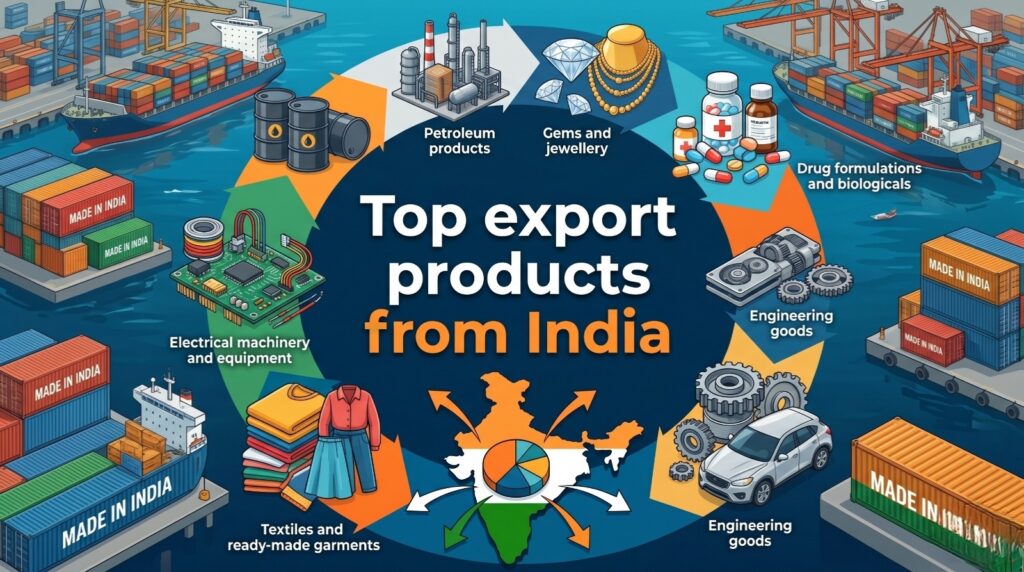
This guide breaks down the top export product categories from India in 2026 — what they are, which countries buy them, what makes India competitive, and how you can enter each sector.
What’s in this guide
Sector 01
Petroleum & refined products
Refined petroleum products — diesel, jet fuel, petrol, naphtha, and lubricants — consistently rank as India’s single largest merchandise export. India’s massive refining capacity, led by Reliance, Indian Oil, and BPCL, processes crude oil imported from the Middle East and Russia into refined products exported globally.
India’s refineries have a combined capacity of over 250 million tonnes per annum, making India one of the world’s top five refining nations. The Jamnagar complex alone is the world’s largest single-location refinery.
Key opportunity: India’s role as a refining hub between crude-producing West Asia and consuming markets in Europe and Southeast Asia creates consistent demand. For traders, petroleum product exports are dominated by large PSUs and Reliance — the opportunity for smaller players is in lubricants, specialty chemicals, and bitumen.
Sector 02
Engineering goods
Engineering goods is India’s most diverse export category, encompassing iron and steel products, industrial machinery, auto components, capital equipment, ships, aircraft parts, and miscellaneous manufactured products. It is the sector where India’s manufacturing push through PLI (Production-Linked Incentive) schemes is showing the most visible results.
Auto components
India is a top-5 global auto component supplier. Exports include castings, forgings, brakes, suspension systems, and EV components. Major buyers: USA, Germany, Thailand.
Steel & iron products
Hot-rolled coils, pipes, fittings, and stainless steel are major export items. India is the world’s 2nd largest steel producer. Top markets: Nepal, UAE, Italy, Vietnam.
Industrial machinery
Textile machinery, food processing equipment, pumps, and compressors. EEPC India is the export promotion council for this sector.
Ships & boats
India’s shipbuilding sector is growing rapidly. New orders for bulk carriers and offshore vessels. Cochin and Mazagon Dock are key exporters.
Sector 03
Gems & jewellery
India dominates the global gems and jewellery market. Surat processes over 90% of the world’s rough diamonds, while Jaipur is the global centre for coloured gemstones, and Mumbai handles the bulk of gold jewellery exports. The UAE CEPA, which gives Indian gems and jewellery zero-duty access to the UAE, has significantly boosted export volumes since 2022.
India exports cut & polished diamonds, plain gold jewellery, studded jewellery, silver articles, and coloured gemstones. The sector employs over 4.64 million people, making it a critical component of India’s employment-intensive export basket.
2026 opportunity: India–UK FTA (expected 2026) will likely eliminate the current 2.5–4% UK tariff on Indian jewellery. This could add $500M+ in annual exports to the UK market alone. GJEPC (Gems & Jewellery Export Promotion Council) is the key body to register with.
Sector 04
Pharmaceuticals & APIs
India is the world’s largest supplier of generic medicines, supplying over 50% of Africa’s generic requirements, 40% of generic demand in the USA, and 25% of all medicines used in the UK. This is not a niche — India is the backbone of global affordable healthcare.
The sector spans finished dosage formulations (FDFs), Active Pharmaceutical Ingredients (APIs), vaccines, biosimilars, and Ayurvedic/herbal products. India has over 3,000 pharma companies and 10,500 manufacturing units, more US FDA-approved plants outside the USA than any other country.
Generic medicines
Largest export segment. Antibiotics, antiretrovirals, cardiovascular drugs, and cancer generics. US is the biggest market, followed by EU and Africa.
API & intermediates
Bulk APIs for global pharma manufacturers. India is reducing dependence on Chinese APIs through PLI incentives. Key clusters: Hyderabad, Ahmedabad, Mumbai.
Vaccines
India supplies 60% of the world’s vaccines by volume. Serum Institute, Bharat Biotech, and Biological E are global leaders. COVAXIN and Covishield built India’s global reputation.
Ayush & herbal
Growing post-COVID. Ayurvedic formulations, herbal supplements, and nutraceuticals. Major markets: USA, UAE, EU, Southeast Asia. Target: $10B by 2030.
How to enter: Register with Pharmexcil (Pharmaceuticals Export Promotion Council of India). All pharma exporters need a Manufacturing Licence, CDSCO registration, and GMP certification. For the US market, US FDA 510(k) or ANDA filing is required. The Australia ECTA gives Indian pharma significantly reduced duties.
Sector 05
Chemicals & agrochemicals
India is the world’s 4th largest agrochemical producer and a growing force in specialty chemicals, dyes, pigments, and industrial chemicals. The chemicals sector includes basic chemicals, dyes & intermediates, agrochemicals (pesticides, herbicides, fungicides), and plastics & polymers.
India produces over 80,000 commercial products across the chemicals sector. Gujarat’s Dahej and Ankleshwar chemical clusters are among Asia’s largest. The China+1 strategy pursued by global companies is driving significant FDI into India’s specialty chemicals sector.
Agrochemical spotlight: India is the 4th largest agrochemical exporter globally. Key products: insecticides (chlorpyrifos, imidacloprid), herbicides, and fungicides. CHEMEXCIL (Basic Chemicals, Cosmetics & Dyes Export Promotion Council) and CAPEXIL are the relevant EPCs.
Sector 06
Textiles & apparel
India is the world’s 2nd largest textile and apparel exporter and the largest producer of cotton globally. The sector spans cotton yarn, fabric, readymade garments (RMG), home textiles, technical textiles, and man-made fibre (MMF) products.
In 2026, India’s textiles sector is receiving a significant boost from the impending India–UK FTA (the UK currently levies 9.6–12% duty on Indian garments) and from the PLI scheme for MMF apparel and technical textiles. Major export clusters include Tiruppur (knitwear), Surat (synthetics), Ludhiana (hosiery), and Jaipur (handicraft textiles).
Cotton yarn & fabric
India is the world’s #1 cotton yarn exporter. Key buyers: Bangladesh, China, Vietnam. Accounts for 25% of textile exports.
Readymade garments
T-shirts, trousers, dresses, and formalwear. USA and EU are dominant buyers. PLI scheme boosted investment in garmenting capacity.
Home textiles
India dominates the global home textiles market — bed sheets, towels, blankets, carpets. Panipat is the “City of Weavers.” Major buyer: USA (40%+ share).
Technical textiles
Fastest-growing segment. Geotextiles, medical textiles, protective wear, and agro-textiles. PLI scheme covers 10 technical textile products.
Sector 07
Agriculture & food products
India is the world’s largest rice exporter, 2nd largest wheat exporter, 2nd largest sugar exporter, and a dominant supplier of spices, seafood, tea, coffee, and processed foods. Agriculture exports exceeded $53 billion in FY25 despite global headwinds, driven by record rice and spice shipments.
| Product | India’s global rank | Key markets | Key EPC |
|---|---|---|---|
| Basmati & non-basmati rice | #1 globally | Saudi Arabia, UAE, Iraq, Nepal | APEDA |
| Spices & spice products | #1 globally | USA, China, Vietnam, Bangladesh | Spices Board |
| Marine products (seafood) | Top-5 exporter | USA, EU, China, Japan, SE Asia | MPEDA |
| Sugar | #2 globally | Indonesia, Bangladesh, UAE, Somalia | APEDA |
| Tea & coffee | #4 tea exporter | Russia, UAE, UK, Germany, USA | Tea Board / Coffee Board |
| Fresh fruits & vegetables | Growing rapidly | UAE, Bangladesh, Malaysia, Oman | APEDA |
Sector 08
IT & software services
India’s IT and software services sector is in a league of its own. With over $254 billion in services exports in FY25, it is the single largest source of India’s export earnings. Bengaluru, Hyderabad, Pune, Chennai, and Noida are home to the world’s largest concentration of software engineers.
In 2026, AI, cloud migration, cybersecurity, and GCC (Global Capability Centres) are the fastest-growing segments. Over 1,700 GCCs of Fortune 500 companies are based in India, employing 1.9 million people. NASSCOM projects India’s tech sector to reach $500 billion by 2030.
IT outsourcing (ITO)
Application development, maintenance, infrastructure management. TCS, Infosys, Wipro, HCL, and Tech Mahindra dominate. Also huge opportunity for mid-size players.
BPO/KPO
Customer support, legal process outsourcing, financial analytics, healthcare data. Moving up the value chain with AI-augmented processes in 2026.
AI & product companies
India’s SaaS startup ecosystem is booming. Freshworks, Zoho, and hundreds of others sell software products globally. This is the highest-margin segment.
GCCs
1,700+ Global Capability Centres in India doing R&D, engineering, and analytics for global multinationals. Massive demand for talent and office space.
Sector 09
Electronics & hardware
Electronics is the most exciting new export growth story from India in 2026. After years of being a net importer, India has transformed into a meaningful electronics exporter, primarily driven by the iPhone manufacturing revolution triggered by Apple’s shift to India through Foxconn and Tata Electronics.
India’s electronics exports have grown from $12 billion in FY22 to over $29 billion in FY25. Mobile phones alone now account for over $15 billion, with Apple iPhones the dominant product. Samsung, Dixon Technologies, and Tata Electronics are the key manufacturers driving export volumes.
PLI scheme impact: The Production-Linked Incentive scheme for large-scale electronics manufacturing has attracted over ₹4,000 crore in investments. India aims to achieve $300 billion in electronics production by 2026, with $120 billion targeted for exports. This is the sector to watch.
Sector 10
Leather & footwear
India is the world’s 2nd largest leather producer and 2nd largest footwear manufacturer, accounting for 13% of the world’s leather production. The sector exports finished leather, footwear, leather garments, and leather goods (handbags, belts, saddlery). Key clusters: Chennai (finished leather), Agra (footwear), Kolkata (leather goods), and Kanpur (industrial leather).
The upcoming India–EU FTA is expected to be transformational for leather and footwear, eliminating the current 3.7–17% EU tariff on Indian leather goods. CLE (Council for Leather Exports) is the key EPC for this sector.
How to start exporting from India in 2026
Whether you are targeting one of the sectors above or a niche product, here is the universal starting framework for new Indian exporters:
Choose product & HS code
Research demand, competition, and margins. Identify the 8-digit HS code for your product on the DGFT portal.
Register your business
Proprietorship, LLP, or Pvt Ltd. Get PAN, GSTIN, and open a current bank account with AD code registration.
Get IEC code
Apply for Import Export Code (IEC) online at dgft.gov.in. Takes 1–3 days. ₹500 fee. Mandatory for all shipments.
Register with EPC
Join the Export Promotion Council for your sector (APEDA, PHARMEXCIL, GJEPC, EEPC etc.) to get RCMC, buyer leads, and scheme benefits.
Find buyers
Use IndiaMART, Alibaba, TradeIndia, EPC trade fairs, and Indian embassy commercial wings. Build a B2B website optimised for your target country.
Handle logistics & payment
Hire a licensed CHA. Use FOB/CIF Incoterms. Secure payment via LC for new buyers, TT for trusted ones. Get ECGC cover.
Claim export incentives: File your Letter of Undertaking (LUT) under GST before April 1 each year to export without paying IGST. Claim RoDTEP (Remission of Duties & Taxes) benefits after each shipment. These can add 2–4% to your effective export margin.
Top export sectors at a glance
| Sector | Est. value | Growth trend | Top EPC | Best FTA |
|---|---|---|---|---|
| Engineering goods | ~$109B | ↑ Growing | EEPC India | UAE CEPA, Japan CEPA |
| IT & services | ~$254B | ↑↑ Fast growth | NASSCOM | Singapore CECA, UK FTA |
| Petroleum products | ~$96B | ⇄ Stable | PCMI / CHEMEXCIL | UAE CEPA |
| Agri & food | ~$53B | ↑ Growing | APEDA / MPEDA | UAE CEPA, ASEAN FTA |
| Textiles & apparel | ~$35B | ↑ Growing | TEXPROCIL / AEPC | Australia ECTA, UK FTA |
| Gems & jewellery | ~$35B | ↑ Growing | GJEPC | UAE CEPA (0% duty) |
| Chemicals & agrochem | ~$30B | ↑↑ Fast growth | CHEMEXCIL / CAPEXIL | EU BTIA (upcoming) |
| Electronics | ~$29B | ↑↑↑ Rapid surge | ELCINA / ICEA | UAE CEPA, Australia ECTA |
| Pharmaceuticals | ~$27B | ↑↑ Fast growth | PHARMEXCIL | Australia ECTA, UAE CEPA |
| Leather & footwear | ~$5B | ⇄ Steady | CLE | EU BTIA (upcoming) |
Frequently asked questions
What is India’s number one export product in 2026?
In terms of merchandise goods, engineering goods (~$109B) and refined petroleum products (~$96B) are India’s top two merchandise export categories. However, if services are included, IT and software services (~$254B) is by far India’s largest export earner overall, making it a critical pillar of India’s $2 trillion export target.
Which is the fastest-growing export sector from India in 2026?
Electronics and hardware is the fastest-growing export sector, driven by Apple iPhone manufacturing through Foxconn and Tata Electronics. Electronics exports have more than doubled from $12 billion in FY22 to over $29 billion in FY25. Chemicals and specialty pharma are close behind, benefiting from China+1 procurement strategies by global companies.
What are the best export products for small businesses in India?
For MSMEs and individual exporters, the most accessible entry points are spices and food products (low capital requirement, strong APEDA support), handicrafts and home textiles (high margins, strong demand from USA and EU), herbal and Ayurvedic products (rapidly growing globally post-COVID), and readymade garments from established clusters like Tiruppur, Surat, or Ludhiana.
Which countries buy the most from India?
India’s top export destinations in 2026 are the USA (~$80B), UAE (~$35B), Netherlands (~$18B), China (~$16B), and the UK (~$12B). The USA and UAE together account for roughly 30% of India’s merchandise exports. For services, the USA alone accounts for over 60% of India’s IT exports.
What government schemes help Indian exporters in 2026?
Key schemes include RoDTEP (duty remission on exports), Interest Equalisation Scheme (subsidised export credit at 3–5% below market rate), EPCG (duty-free import of capital goods for export production), PLI schemes (sector-specific production incentives for electronics, pharma, textiles, and 10 other sectors), and MAI/MDA funds from DGFT for market development and trade fair participation.
Ready to start exporting from India?
Whether you are targeting the UAE, USA, EU, or Australia — the right product, IEC code, and EPC registration can get you exporting within weeks. Start your journey today.
Get export guidance →