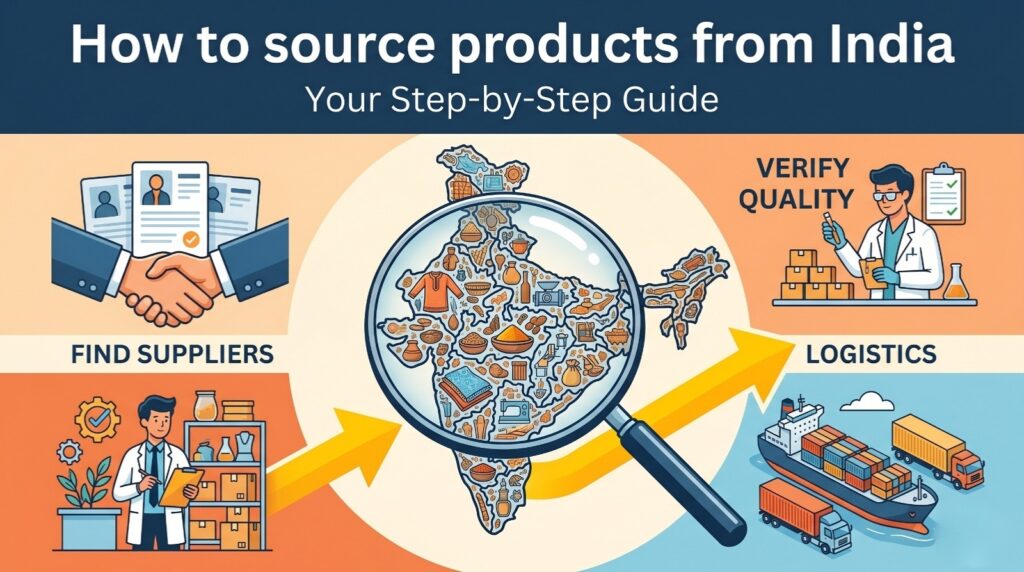
India is one of the world’s most powerful sourcing destinations — and in 2026, it is more accessible than ever. With a manufacturing base spanning pharmaceuticals, textiles, engineering goods, handicrafts, electronics, spices, gems, chemicals, and much more, India can supply almost any product category you need.
But sourcing from India successfully requires knowing where to look, how to verify suppliers, how to negotiate correctly, and how to protect yourself legally and financially. This guide walks you through every step — from your first product search to goods arriving at your warehouse.
What’s in this guide
- Why source from India in 2026?
- Best products to source from India
- How to find Indian suppliers
- How to verify & vet suppliers
- Requesting samples & pricing
- How to negotiate with Indian suppliers
- Quality control & inspection
- Payment methods & protection
- Shipping, Incoterms & logistics
- Legal & compliance essentials
- Mistakes to avoid
- Frequently asked questions
Why source from India in 2026?
India has quietly become the world’s preferred alternative to China for international sourcing — and for good reason. Here is why global buyers are turning to India in 2026:
Highly competitive pricing
Labour costs in India remain 30–60% lower than in China, the EU, and the USA. This makes Indian suppliers extremely price-competitive, especially in labour-intensive categories like textiles, handicrafts, and leather goods.
English-speaking business culture
Unlike sourcing from China or Southeast Asia, almost all Indian business communication happens in English. Contracts, emails, specifications, and negotiations are straightforward without translation barriers.
China+1 diversification
Global supply chain disruptions from 2020–2022 accelerated the shift away from single-source dependence on China. India is the #1 beneficiary of this China+1 strategy across pharma, chemicals, electronics, and textiles.
Strong IP and legal framework
India has a well-established legal system based on English common law. Contracts are enforceable. IP protection through patents, trademarks, and designs is robust compared to other Asian sourcing markets.
FTA advantages for buyers
If you are in the UAE, Australia, Japan, South Korea, or Southeast Asia, India’s active FTAs mean you could import many Indian products at zero or reduced duty — a direct cost saving for your business.
World-class manufacturing clusters
India has dedicated, world-class clusters for almost every product category — Surat for diamonds, Tiruppur for knitwear, Moradabad for brassware, Agra for footwear, Hyderabad for pharma. Deep specialisation drives quality.
Best products to source from India in 2026
India’s manufacturing clusters are highly specialised. Here are the top product categories, where they are made, and why India excels:
| Product category | Key manufacturing hubs | Why India leads |
|---|---|---|
| Textiles & apparel | Tiruppur, Surat, Ludhiana, Jaipur | World’s largest cotton producer, 30-40% cheaper than EU |
| Handicrafts & home décor | Moradabad, Jodhpur, Jaipur, Saharanpur | Unique artisanal skills, low MOQs, high customisation |
| Spices & food ingredients | Kerala, Rajasthan, Gujarat, AP | #1 global spice producer & exporter |
| Pharmaceuticals & APIs | Hyderabad, Ahmedabad, Mumbai | World’s largest generic medicine supplier, US FDA-approved |
| Gems & jewellery | Surat, Mumbai, Jaipur | 90% of world’s diamonds cut & polished here |
| Leather & footwear | Agra, Chennai, Kanpur, Kolkata | World’s 2nd largest leather producer |
| Engineering & auto components | Pune, Chennai, Rajkot, Coimbatore | Top-5 global auto component supplier, precision manufacturing |
| Chemicals & agrochemicals | Gujarat (Dahej, Ankleshwar), Mumbai | #4 global agrochem producer, China+1 winner |
| Organic food & nutraceuticals | Uttarakhand, Himachal, MP, Rajasthan | Fastest growing segment; wide organic-certified supplier base |
| Furniture & wooden products | Jodhpur, Saharanpur, Rajasthan | Hand-carved, custom-finish, significantly lower cost than EU |
India vs China for sourcing: India is generally better than China for textiles, pharmaceuticals, spices, handicrafts, leather, and specialty chemicals. China still holds an edge in electronics components, mass-produced plastic goods, and certain heavy machinery. Many buyers now source 50% from India + 50% from China to hedge risk.
How to find Indian suppliers
There are several reliable channels for finding Indian suppliers, each with different strengths. Use a combination for best results.
IndiaMART
India’s largest B2B marketplace with 7 million+ suppliers across all categories. Free to browse. Verified TrustSEAL badges indicate screened suppliers. Best starting point for any sourcing search.
TradeIndia
India’s second-largest B2B portal. Good for industrial, chemical, and food sector suppliers. Check the “Verified” badge and company profile age before contacting.
Alibaba (India suppliers)
Many Indian suppliers list on Alibaba. Use the “Filter by supplier country: India” option. Look for Gold Supplier status and Trade Assurance badge for additional safety.
Trade fairs & expos
India Trade Promotion Organisation (ITPO) events, IHGF Delhi Fair (handicrafts), India International Trade Fair, and sector-specific EPC fairs. Meeting suppliers in person is the fastest trust builder.
Export Promotion Councils
Each sector has a government-backed EPC (APEDA for agri, PHARMEXCIL for pharma, EEPC for engineering, GJEPC for gems). Their member directories list verified, active exporters. Highly reliable.
Sourcing agents
India-based sourcing agents or buying houses handle supplier discovery, factory visits, sampling, negotiation, and quality inspection for a fee (typically 3–8% of order value). Ideal for first-time buyers or complex categories.
LinkedIn & direct outreach
Many Indian exporters are active on LinkedIn. Search by city + product + “exporter.” Direct outreach to verified company profiles can yield responsive, professional suppliers who may not be on B2B portals.
Indian embassy & FIEO
Indian embassies in your country have commercial wings that connect foreign buyers with Indian suppliers. FIEO (Federation of Indian Export Organisations) maintains a searchable exporter database.
How to verify and vet Indian suppliers
Finding a supplier is easy. Finding a reliable supplier requires due diligence. Always verify before you pay. Here is exactly what to check:
Check GST registration
Ask for the supplier’s GSTIN. Verify it free at gst.gov.in. A valid GSTIN confirms the business is registered and active in India.
Verify IEC code
Any legitimate Indian exporter has an IEC (Import Export Code). Verify it at dgft.gov.in under the IEC search tool. No IEC = cannot legally export.
MCA company check
For Pvt Ltd or LLP companies, verify registration at mca.gov.in. Check the company’s date of incorporation, directors, and filing status. Dormant filings = warning sign.
Request trade references
Ask for 2–3 existing international buyer references and actually contact them. Legitimate exporters welcome this. A supplier who refuses or delays is a red flag.
Factory audit or virtual tour
For orders above $10,000, commission a factory audit from Bureau Veritas, SGS, or Intertek India. If budget is tight, a live video call factory walkthrough is a good minimum step.
Check certifications
Relevant certs depending on product: ISO 9001, US FDA, CE mark, BIS, FSSAI (food), GMP (pharma), OEKO-TEX (textiles), Fair Trade (artisanal). Always ask for the original certificate and verify expiry dates.
Common scam warning: Be wary of suppliers who ask for a large advance payment (over 30%) before samples are approved, who cannot provide a physical factory address, or whose bank account name differs from their company name. Always verify banking details independently before any transfer.
Requesting samples and getting pricing right
Never place a bulk order without approving samples first. This is the golden rule of sourcing from any country, and India is no exception. Here is how to do it correctly:
Step 1: Send a detailed spec sheet
Provide exact product specifications: dimensions, materials, colour codes (Pantone), weight, packaging requirements, labelling, and certifications needed. The more specific you are, the fewer correction rounds you will need.
Step 2: Pay for samples
Most Indian exporters will charge for samples (typically $20–$100 per sample + courier cost). This is normal and not a red flag. Suppliers who offer free samples are sometimes working in low-quality volumes. Sample cost is often deducted from the first bulk order.
Step 3: Evaluate sample systematically
Use a written checklist: dimensions, weight, material quality, stitching/finishing, colour accuracy, packaging, and label compliance. Document everything with photos. Send written feedback, not just verbal.
Step 4: Get a proper quotation
Ask for a formal Pro Forma Invoice (PI) that states the unit price, MOQ, Incoterm (FOB/CIF), port of loading, lead time, payment terms, and validity period. This is your pricing baseline for negotiation.
MOQ reality check: India’s MOQs are generally more flexible than China’s. Many Indian suppliers — especially in handicrafts, textiles, and food — accept MOQs as low as 50–200 units. For manufactured goods like auto components or pharma, MOQs are typically higher. Always ask for their absolute minimum, then negotiate upward for a price break.
How to negotiate with Indian suppliers
Negotiation with Indian suppliers is an expected part of the business process — but it has its own culture and conventions. Understanding these will get you better outcomes.
✓ Build relationship first
Indian business culture is relationship-driven. Spend a few exchanges building rapport before diving into hard price negotiations. A warm relationship gets you better flexibility on price, MOQ, and lead time.
✓ Always counter the first price
The first quoted price almost always has 10–20% margin built in. It is expected that you will counter. A polite “Can you give me your best price for this volume?” is a standard opening. Never accept the first number without trying.
✓ Leverage volume
Commit to higher volume in exchange for lower unit price. “If I order 500 units instead of 200, what is your best price?” Indian suppliers reward loyalty and volume consistency.
✓ Negotiate payment terms
A typical structure is 30% advance + 70% before shipment. Once trust is built over 2–3 orders, push for 30% advance + 70% on Documents Against Payment (DP) or LC at sight. Better payment terms can be traded for slightly higher prices.
✗ Avoid unrealistic lowballing
Pushing the price too hard drives suppliers to cut corners on quality, materials, or labour standards. A 5% cheaper price is not worth a 20% defect rate. Know the market price for your product before negotiating.
✗ Do not negotiate via WhatsApp only
WhatsApp is widely used in Indian trade, but critical agreements — price, specification, delivery date, penalties — must always be confirmed in a formal email or contract. Verbal and WhatsApp commitments are difficult to enforce.
Quality control & inspection
Quality control is the area where most sourcing problems occur. A good QC framework prevents costly returns, rejected shipments, and damaged customer relationships.
Before production starts, confirm raw materials, components, and colours match your approved sample. Prevents entire batches being produced with wrong inputs.
Inspect when 20–30% of production is complete. Catches problems early when corrections are still cost-effective. Especially important for large, complex, or first-time orders.
The most critical checkpoint. Inspect when 80–100% of goods are packed. Use AQL (Acceptable Quality Level) sampling standards. Must be done before payment is released.
Use SGS, Bureau Veritas, Intertek, or QIMA for independent inspections. Cost: typically $200–$400 per inspection day. Worth every rupee for orders above $5,000.
AQL sampling explained: AQL (Acceptable Quality Level) is the industry standard for deciding how many units to inspect and how many defects are acceptable. AQL 2.5 is standard for general goods (accept up to 2.5% minor defects). AQL 1.0 is used for higher quality requirements. Your inspection company will handle this automatically.
Payment methods & how to protect yourself
How you pay determines how protected you are. Here are the main payment options for sourcing from India, from safest to highest risk:
| Method | Buyer protection | Seller acceptance | Best for |
|---|---|---|---|
| Letter of Credit (LC) | Highest | Universally accepted | Large orders, new suppliers |
| Documents Against Payment (DP) | High | Widely accepted | Repeat orders, trusted suppliers |
| 30% advance + 70% before shipment | Medium | Most common | Standard first-order structure |
| Alibaba Trade Assurance | Medium | Alibaba-listed suppliers | Smaller orders via Alibaba |
| 100% advance payment (TT) | Lowest | Preferred by sellers | Only for very well-known, audited suppliers |
Never pay 100% advance to a new supplier. Regardless of how convincing the supplier is or how urgent the order, a 100% advance to an unverified supplier is one of the most common ways to lose money in international sourcing. Standard first-order practice: 30% advance after sample approval, 70% balance after pre-shipment inspection report.
Shipping, Incoterms, and logistics
Getting goods from India to your country involves choosing the right shipping mode, the right Incoterm, and working with a good freight forwarder. Here are the key decisions:
Sea freight (FCL/LCL)
Best for large orders. FCL (full container load) for 10+ CBM; LCL (less than container load) for smaller shipments. Transit time: 15–35 days. Key Indian ports: JNPT (Mumbai), Mundra, Chennai.
Air freight
Best for high-value, low-weight goods (pharma, electronics, gems) or urgent shipments. Transit time: 3–7 days. 4–6x more expensive than sea. Key airports: Delhi IGIA, Mumbai CSIA, Bengaluru.
Courier (DHL / FedEx)
Best for samples and small orders below 50kg. Fast (3–5 days), trackable, but expensive per kg. DHL and FedEx have strong networks across India for pickup.
Use FOB as buyer
As a buyer, always prefer FOB (Free On Board) terms. This means you control freight booking, cost, and insurance from the Indian port. You get better rates through your own forwarder and full visibility.
Important for UAE, Australia, Japan, and ASEAN buyers: India has active FTAs with your region. When importing, ask your Indian supplier for a Certificate of Origin (CoO) and declare the FTA preference in your import customs entry. This can eliminate or significantly reduce your import duty — a direct saving on every order.
Legal & compliance essentials for buyers
Protecting yourself legally is just as important as finding a good price. These are the legal foundations of safe sourcing from India:
Written Purchase Order
Always issue a formal Purchase Order (PO) that includes product specs, quantity, price, Incoterm, delivery date, payment terms, and quality standards. Your PO is your primary legal document.
Non-Disclosure Agreement
Before sharing proprietary designs, formulations, or brand specifications, sign an NDA. India’s contract law recognises NDAs fully. Use a lawyer familiar with cross-border IP to draft it.
Trademark your brand in India
If you are doing significant sourcing from India and have a brand, register your trademark with the Indian Trade Marks Registry (ipindia.gov.in). This prevents suppliers from using your brand mark domestically.
Dispute resolution clause
Your contract must specify how disputes are resolved. Common choices: ICC Arbitration in Singapore or London (internationally neutral), or Delhi High Court jurisdiction (if comfortable with Indian courts).
Compliance certifications
Ensure your supplier’s goods meet your destination country’s standards: CE mark (EU), FCC/FDA (USA), TGA (Australia). Request test reports from accredited labs (BIS, NABL-certified) with every shipment.
Import customs in your country
Know the HS code and import duty for your product in your country. Use a licensed customs broker at your end to ensure smooth clearance and avoid detention, which is costly. Check restricted/prohibited items list.
Common mistakes buyers make when sourcing from India
Skipping factory verification: Trusting a nice website and catalogue without verifying the factory’s existence or capacity. Many “factories” on portals are actually trading companies. Always ask for factory registration documents and video proof.
Placing a large first order: Always start with a small trial order (even if MOQ allows larger) to test the supplier on quality, communication, and delivery accuracy. Scale up only after 1–2 successful orders.
Not defining quality standards in writing: Telling a supplier “good quality” means nothing. Define exact tolerances, AQL levels, acceptable defect categories, and what happens if standards are not met — all in your PO or quality agreement.
Choosing the cheapest supplier: The cheapest price almost always means compromised quality, labour shortcuts, or sub-standard materials. India has excellent suppliers at fair prices — the goal is value, not the lowest price.
Ignoring lead times: Indian suppliers can have longer lead times (30–60 days) for custom/made-to-order products. Plan your inventory cycle with this buffer built in. Festival seasons (Diwali — Oct/Nov, holidays in August) often cause delays.
Not checking import duties in your country: Before finalising your product and supplier, check your home country’s import duty for that HS code. A 25% import duty can wipe out your entire cost saving from sourcing in India. Check if an FTA with India applies to reduce it.
Frequently asked questions
How do I find reliable suppliers in India?
The most reliable channels are IndiaMART (India’s largest B2B portal with 7M+ suppliers), Export Promotion Council directories (APEDA for agri, PHARMEXCIL for pharma, EEPC for engineering, GJEPC for gems), FIEO’s exporter database, and trade fairs like the IHGF Delhi Fair. Always verify by checking GSTIN at gst.gov.in, IEC at dgft.gov.in, and company registration at mca.gov.in.
What is the minimum order quantity (MOQ) from Indian suppliers?
MOQs vary widely by product and supplier. Handicrafts and textiles often have MOQs as low as 50–200 units. Industrial goods, auto components, and pharmaceutical products typically require higher minimums. Indian suppliers are generally more flexible on MOQ than Chinese counterparts, especially if you commit to repeat orders or build a relationship first.
Is it safe to source products from India?
Yes — sourcing from India is safe when you follow due diligence. Verify GSTIN and IEC, approve samples before bulk orders, use a 30% advance + 70% before shipment payment structure, commission a pre-shipment inspection, and always use a formal written Purchase Order. India has a robust legal framework based on English common law, and contracts are enforceable through Indian courts or international arbitration.
How long does shipping from India take?
Sea freight from India typically takes 7–10 days to UAE, 18–22 days to Australia, 20–25 days to Europe, and 22–28 days to the US East Coast. Air freight takes 3–7 days to most destinations. DHL/FedEx courier for samples takes 3–5 days. Always add 5–7 days for customs clearance at your end.
Do I need a sourcing agent to buy from India?
Not necessarily. Many buyers source directly using IndiaMART and trade fair contacts. However, a sourcing agent (fee: 3–8% of order value) is highly valuable for first-time buyers, complex multi-product sourcing, or when you need factory visits, quality inspections, and logistics managed locally without travelling to India. Consider using an agent for your first 1–2 orders, then go direct once you know the landscape.
How do I reduce import duty on products from India?
If your country has an active FTA with India — UAE (CEPA), Australia (ECTA), Japan (CEPA), South Korea (CEPA), Singapore (CECA), or ASEAN nations (FTA) — you can import many Indian products at reduced or zero duty. Ask your Indian supplier for a Certificate of Origin (CoO) and declare the FTA preference in your customs entry. Verify the specific duty rate for your product’s HS code on the DGFT tariff schedule or your country’s customs portal.
Ready to start sourcing from India?
Whether you need a single verified supplier or a full procurement strategy — we help global buyers source from India with confidence, speed, and zero guesswork.
Start sourcing from India →